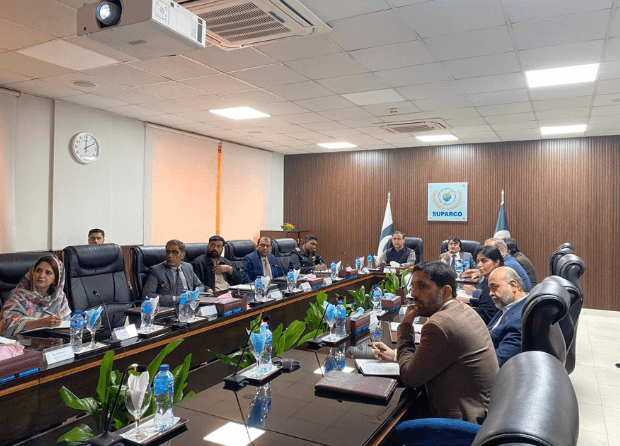
KARACHI: Federal Minister for Maritime Affairs Muhammad Junaid Anwar Chaudhry, on Wednesday, emphasized that advanced space-based monitoring systems could play a crucial role in safeguarding seas, improving maritime management, and strengthening responses to environmental threats.
Chaudhry made these remarks during a visit to the headquarters of SUPARCO, marking the first-ever such visit by any maritime affairs minister in the country.


During the visit, Chairman SUPARCO Yusuf Khan and senior officials provided the minister with a detailed briefing on the organization’s operations and technological capabilities. The discussions focused on SUPARCO’s role in satellite monitoring, maritime safety, and port management.
The minister was presented with a satellite-based assessment of potential sites for new ports, reflecting Pakistan’s focus on expanding its maritime infrastructure. Additionally, officials outlined plans for relief and rescue operations within national maritime boundaries, leveraging satellite technology and artificial intelligence to enhance efficiency and response times.
Addressing the participants, Junaid Chaudhry emphasized the importance of using satellite technology to tackle environmental and ecological challenges, including the impacts of climate change and disaster risks facing the country’s coastline and maritime sector. He stressed the need to conserve ocean biodiversity, ensure the sustainable use of marine resources, and enhance cooperation on marine environmental protection. He noted that Pakistan is working to align its national maritime policies with global conservation commitments.
The minister highlighted the increasing importance of protecting marine life, particularly in areas beyond national jurisdiction. He also pointed out that Pakistan is a member of the Ocean Biodiversity Treaty, supporting international efforts to protect ocean ecosystems and ensure the long-term sustainability of marine resources.
During the briefing, SUPARCO officials proposed developing AI-based solutions for ports, including systems to monitor cargo dwell time and address customs-related inefficiencies through AIMS. The meeting also explored ways to institutionalize cooperation between the ministry and SUPARCO. Chaudhry announced that a formal signing ceremony would be held to systematize collaboration and provide a structured framework for joint initiatives. Both sides agreed to appoint focal persons to expedite coordination and implementation of agreed projects.
SUPARCO officials highlighted the organization’s role in space science and satellite technology, with particular emphasis on maritime applications. They briefed the minister on the use of high-resolution satellite imagery and digital modeling to monitor mangroves, track maritime traffic, and detect oil spills along the coast.
The minister was also informed about SUPARCO’s capabilities in cyclone and storm surge hazard detection through coastal storm surge modeling. Chaudhry praised the agency’s contribution to disaster management, noting that early warning systems could help alert coastal communities ahead of severe weather events, potentially saving lives and reducing economic losses.
Chaudhry further lauded SUPARCO’s participation in the international Cospas-Sarsat program, which provides satellite-based search and rescue services. He stated that Pakistan could gain further benefits by integrating beacon-based systems into maritime operations to enhance safety and emergency response at sea.
In addition, SUPARCO briefed the minister on urban flood hazard modeling and its potential integration into future planning for coastal and port safety. Officials noted that continuous monitoring systems could help address coastal pollution, seawater intrusion, and broader environmental compliance challenges.
“We can benefit from continuous monitoring of coastal ecosystems to assess water quality, sediment dispersion, and overall environmental health,” the minister said, adding that data-driven approaches were essential for informed policymaking in the maritime sector.
The minister concluded by noting that Pakistan’s coastline is increasingly vulnerable to climate-related threats, such as rising sea levels, coastal erosion, and extreme weather. He emphasized the importance of stronger collaboration between maritime authorities and scientific institutions.