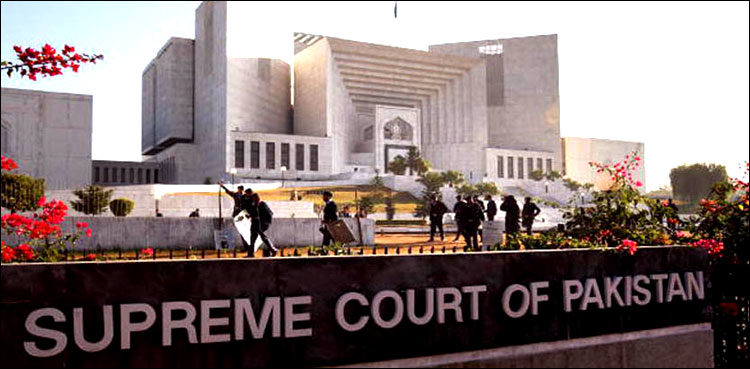
ISLAMABAD: The Supreme Court has strongly criticised government departments, particularly tax authorities, for mechanically filing appeals and petitions on legal issues that have already been conclusively settled by superior courts, warning that such practices cause serious institutional harm and waste judicial resources.
In a six-page judgment authored by Justice Miangul Hassan Aurangzeb, a three-member bench of the Supreme Court, headed by Justice Naeem Akhtar Afghan, observed that the state must act as a responsible and fair litigant, rather than behaving like a compulsive appellant by pursuing frivolous litigation.


The court directed the Chairman Federal Board of Revenue (FBR) to examine whether questions of law raised in future appeals already stand settled by judgments of the Supreme Court or High Courts before such matters are taken to appellate forums.
Recommendation to Form Independent Vetting Committees
The judgment declared it imperative for the FBR to consider constituting independent screening committees to vet each reference or appeal before filing it in a court of law. These committees should function with complete independence and examine cases in a timely manner.
According to the court, such committees may include:
A retired judge of the superior judiciary
An experienced tax practitioner
A senior serving or retired FBR officer with an unblemished record
The aim, the court noted, is to ensure careful legal scrutiny and internal accountability within government departments.
Background of the Case
The ruling arose from an appeal filed by the Assistant Commissioner, Inland Revenue Unit-III, Zone Cantt, RTO Rawalpindi, against a March 10, 2025 judgment of the Lahore High Court (LHC), which had ruled in favour of a private taxpayer.
The dispute began when the RTO Rawalpindi issued a notice on November 15, 2023 to taxpayer Umer Tariq Khan, alleging inadmissible input tax of Rs4 million. However, the Order-in-Original imposing tax liability was passed on March 20, 2024, beyond the 120-day mandatory time limit prescribed under Section 11(5) of the Sales Tax Act, 1990.
LHC and SC Findings
The taxpayer challenged the assessment before the LHC, which relied on earlier Supreme Court precedents, including Inland Revenue Commissioner vs POF Welfare Packages, and ruled that the statutory time limit was mandatory, rendering the assessment invalid.
Despite settled law on the issue, the FBR filed an appeal before the Supreme Court, which was dismissed outright.
The apex court noted that government departments often pursue appeals even when the outcome is foreseeable, a practice that has repeatedly been deprecated by the Supreme Court in previous judgments.
Courts Empowered to Curb Frivolous Litigation
The bench clarified that courts possess both constitutional authority and jurisprudential tools to curb such practices. These include:
Dismissing appeals in limine (at the threshold)
Identifying officers who authorised frivolous litigation
Imposing costs on departments
The court stressed that internal accountability and rigorous legal examination before filing appeals are essential to prevent misuse of judicial time.
‘Serious Institutional Harm’ Identified
The judgment warned that routine filing of appeals on settled legal questions causes serious institutional harm, including:
Backlog of pending cases
Waste of scarce judicial time
Delays in criminal cases involving personal liberty
Prolonged civil and constitutional disputes
Such conduct undermines the constitutional mandate of speedy justice, the court observed.
Failure to Substantiate Department’s Claims
The Supreme Court also noted that the department failed to substantiate its claim that delays occurred due to repeated adjournments sought by the taxpayer. No order sheet from assessment proceedings was placed on record, and the claim was found to be incorrect even before the High Court.
Warning to Government Departments
The court regretted that when the state itself disregards binding precedents, it sends negative signals to subordinate courts, tribunals, and litigants. Such litigation results in unnecessary public expenditure on legal fees, court costs, and administrative processing, further burdening the justice system.
The judgment reaffirmed that government departments must uphold the rule of law by respecting settled judicial principles and exercising restraint in litigation.