ISLAMABAD: Federal Minister for Finance and Revenue, Senator Muhammad Aurangzeb described the ongoing Middle East conflict as one of the largest supply shocks in recent history, comparable in scale to the demand shock experienced during COVID-19.
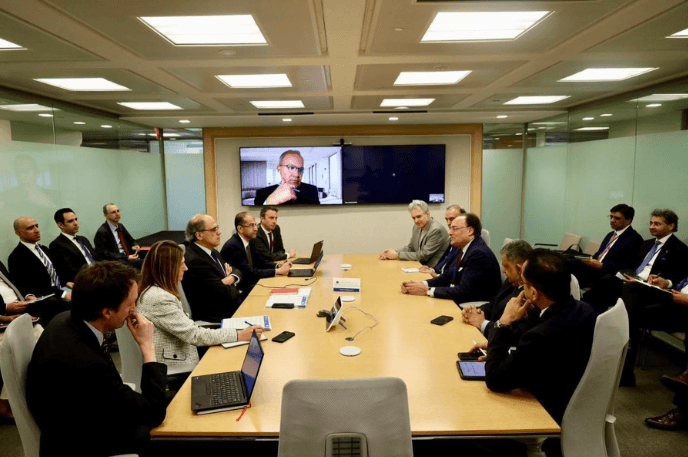
Participating in panel discussion on “MENAP Economies Navigating War: Managing Shocks and Shaping the Future,” organized by the International Monetary Fund (IMF), the minister noted that the crisis had triggered a broader global conversation on energy security and supply chain resilience, said a press release issued by Finance Ministry here Wednesday.

He elaborated on the first-order impact of the crisis on fuel availability and pricing, while outlining Pakistan’s ongoing scenario planning for potential second and third-order effects, including implications for inflation, remittances, exports, and capital flows.
Highlighting an emerging silver lining, the Finance Minister noted that transshipment volumes at Karachi Port over the past 25–30 days had exceeded those recorded during the entire previous year, reflecting evolving opportunities in the global trade landscape.
He underscored that building strategic reserves remains a key take-away from the current crisis and identified two important lessons being applied to the present situation including the importance of maintaining fiscal discipline supported by targeted delivery mechanisms, and the transformative role of technology in enhancing economic resilience.
The minister also interacted with the US-Pakistan Business Council and representatives of U.S. companies operating in Pakistan, during which he briefed the participants on Pakistan’s macroeconomic outlook and reform progress.
He highlighted that Pakistan had secured a Staff-Level Agreement (SLA) with the International Monetary Fund (IMF) on the third review of the Extended Fund Facility (EFF) and the second review of the Resilience and Sustainability Facility (RSF), with approval by the IMF Executive Board expected shortly.
He outlined the economic impact of the ongoing conflict in the Middle East, particularly in terms of energy procurement, pricing, and logistics. He elaborated on the government’s policy response, including measures focused on supply chain stabilization, demand management, and the provision of fiscally-neutral targeted subsidies.
Senator Aurangzeb highlighted emerging positive developments, including a significant surge in transshipment volumes through Karachi Port and record inflows under the Roshan Digital Account initiative.
Aurangzeb also held a meeting with Dan Katz, First Deputy Managing Director IMF and expressed gratitude for the IMF mission team’s seamless handling of the third review under the Extended Fund Facility (EFF) and the second review under the Resilience and Sustainability Facility (RSF).
He informed that a staff-level agreement had been successfully concluded and that approval by the IMF Executive Board was awaited.
He briefed Katz on the immediate impact of the ongoing conflict on Pakistan’s economy, particularly in relation to energy procurement and logistics and outlined the government’s policy response, including demand management measures and fiscally-neutral targeted subsidies designed to protect the most vulnerable segments of the population.
He further apprised the IMF leadership of Pakistan’s ongoing assessment of the second and third-order effects of the crisis, including implications for inflation, growth, exports, and remittances.
The Finance Minister welcomed the IMF mission’s expected visit next month for budget discussions, including deliberations on taxation matters.
He reaffirmed Pakistan’s unwavering commitment to the programme anchor, underscoring its role as a credible source of stability and market confidence in the face of the prevailing external shock.
The minister while addressing Pakistan Diaspora Leaders’ Evening paid rich tribute to the invaluable contributions of the Pakistani diaspora to the country’s economic development, recognizing overseas Pakistanis as a cornerstone of Pakistan’s external resilience.
He underscored the continued commitment to the Roshan Digital Account (RDA) scheme, emphasizing that even at the height of Pakistan’s balance of payments crisis—when foreign exchange reserves had fallen to historic lows—no restrictions were placed on deposits in RDA accounts.
He appreciated the new features and enhancements introduced to the scheme, which have broadened the range of investment options available to account holders. He urged expatriate Pakistanis to take advantage of the opportunity and invest in Pakistan’s economy through the RDA platform.
Aurangzeb also held a meeting with Howard Lutnick, Secretary of the United States Department of Commerce. Both sides discussed avenues for deepening bilateral economic partnership, with a focus on enhancing trade, promoting investment flows, and facilitating private-sector engagement.
The discussions also covered cooperation in key sectors including mining, energy, and information technology, with an emphasis on unlocking new opportunities for mutually beneficial economic collaboration.