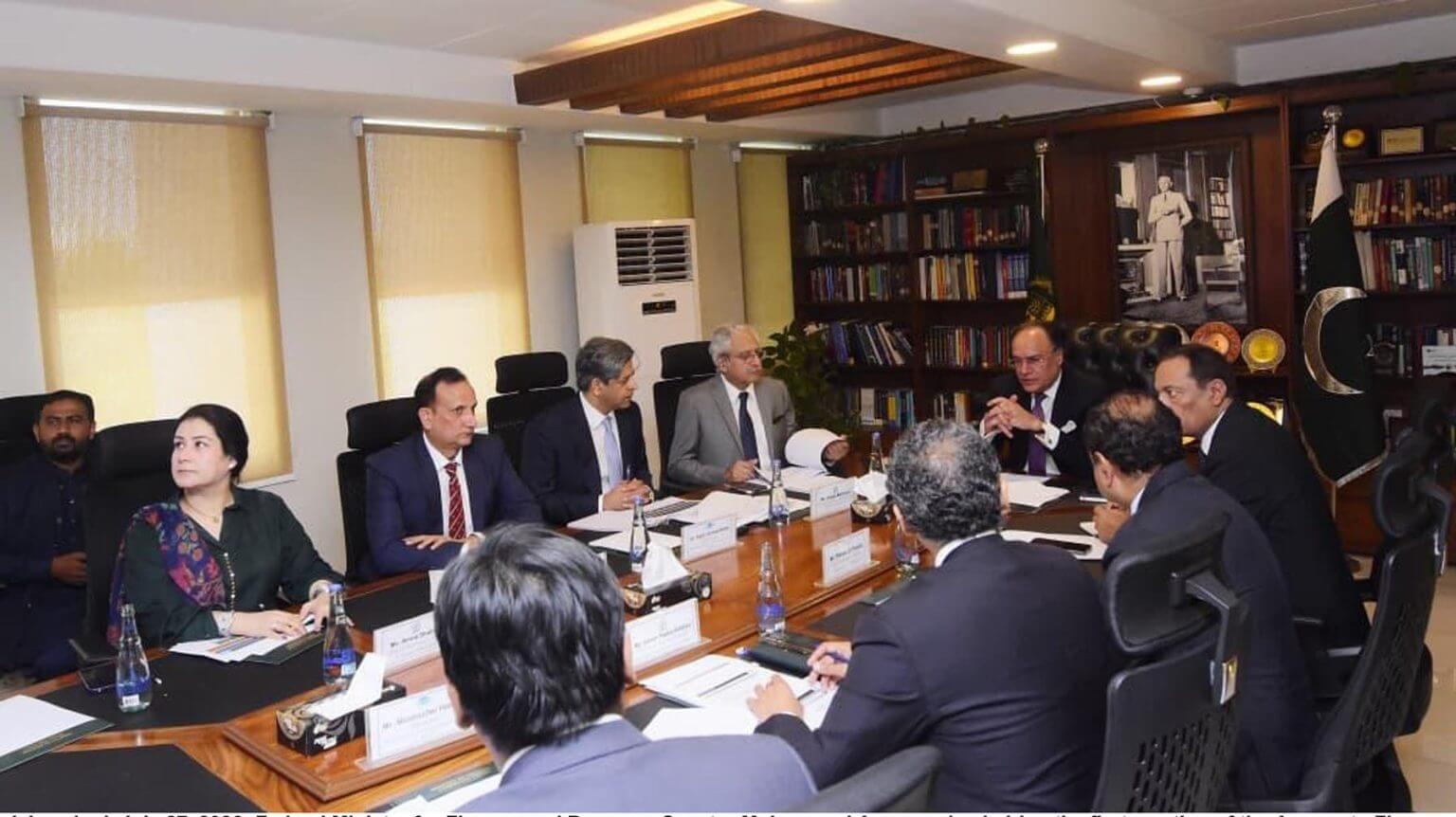
ISLAMABAD: Federal Minister for Finance and Revenue Senator Muhammad Aurangzeb on Monday chaired the maiden meeting of the Access to Finance Steering Committee and directed all stakeholders to accelerate implementation of the Prime Minister’s Access to Finance Plan 2026–2028 to improve affordable credit for key sectors of the economy.
The committee, constituted to provide strategic oversight of the Prime Minister’s Access to Finance Plan, reviewed measures aimed at expanding affordable financing for small and medium enterprises (SMEs), agriculture, information technology (IT), exports, renewable energy and housing, a news release said.


The meeting received a comprehensive presentation on the proposed governance structure, targeted outcomes and implementation workstreams designed to expand access to finance, strengthen financial inclusion and enhance affordable lending for priority sectors.
Members were also briefed on progress made by the SME Finance Sub-Committee and reviewed the implementation status of the government’s flagship financing initiatives, including Zarkhez-e (Asaan Zarai Qarza), the Apna Ghar Scheme and the Pakistan Accelerated Vehicle Electrification (PAVE) initiative, which promotes affordable electric bikes and e-rickshaws.
The committee discussed a proposed three-tier governance framework comprising monthly progress updates to the Prime Minister, fortnightly strategic oversight by the Steering Committee chaired by the finance minister, and weekly meetings of sector-specific sub-committees.
Participants also reviewed a reporting framework featuring Resolution Target Dates (RTDs), a structured escalation mechanism and periodic reporting to strengthen accountability and monitor progress across all implementation workstreams.
The finance minister also stressed the need for an effective progress-monitoring dashboard.
Addressing the meeting, Senator Aurangzeb said the Steering Committee would serve as the central platform for strategic oversight, policy coordination and progress monitoring, enabling timely decision-making, addressing cross-cutting challenges and fostering closer collaboration among regulators, financial institutions and implementing agencies.
He said the committee should remain focused on delivering measurable outcomes while providing an effective mechanism to resolve policy and operational issues affecting access to finance.
The meeting also reviewed the progress of flagship financing programmes, particularly Zarkhez-e (Asaan Zarai Qarza), focusing on application processing, approvals and loan disbursements by participating banks.
Participants were also updated on the Apna Ghar Scheme and the PAVE initiative, including application volumes, approvals, disbursements and operational challenges requiring continued engagement with participating institutions.
The committee further discussed national targets for SME financing, including increasing outstanding SME credit, expanding the share of SME lending in the banking sector and significantly increasing the number of active SME borrowers through a results-oriented monitoring framework.
Members were also briefed on ongoing reforms, including SME credit scoring, development of an Open Banking Framework and SME Digital Portal, integration with credit bureaus and measures to strengthen financing across key value chains.
The finance minister said the success of the Access to Finance Plan would depend on disciplined implementation, clear accountability and sustained institutional coordination.
He emphasised adherence to agreed timelines, stronger inter-agency collaboration and regular monitoring through data-driven performance indicators, adding that the Steering Committee would play a pivotal role in sustaining reform momentum, removing implementation bottlenecks and advancing the plan’s objectives.
The meeting was attended by Finance Secretary Imdadullah Bosal, the Governor of the State Bank of Pakistan, the Chairman of the Securities and Exchange Commission of Pakistan (SECP), the Chairman of the Pakistan Banks’ Association (PBA), the Chief Executive Officer of Karandaaz Pakistan, and senior representatives of the Finance Division, the State Bank of Pakistan and the SECP.