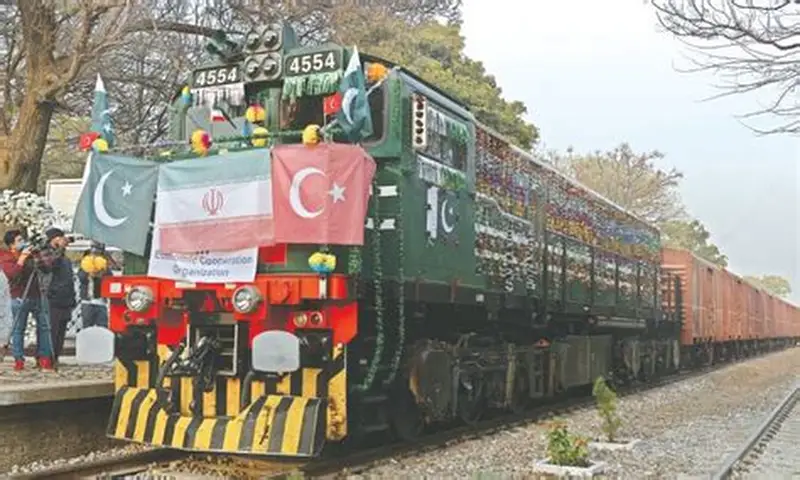
LAHORE: Federal Minister for Railways Muhammad Hanif Abbasi held a high-level meeting with Türkiye’s Minister of Transport and Infrastructure, Abdulkadir Uraloğlu, during his two-day official visit to Türkiye, with both sides agreeing to strengthen cooperation in railways, particularly through investment, modernisation, technology transfer and regional connectivity.
The two sides agreed on the importance of reviving the Islamabad–Tehran–Istanbul (ITI) Freight Corridor at the earliest and developing it into a sustainable trade route linking South Asia, Central Asia and Europe. They also discussed infrastructure and logistics cooperation for the corridor, which is expected to improve connectivity between Pakistan, Iran and Türkiye and create new economic opportunities in the region.

The Pakistani delegation briefed the Turkish side on the modernization of Main Line-3 (ML-3) from Rohri to Taftan, highlighting its importance for rail connectivity with Iran and future freight operations through the ITI Corridor. Progress on the Karachi–Rohri section of Main Line-1 (ML-1) was also discussed, with Turkish companies invited to explore investment opportunities in the remaining phases of the project.
The meeting also covered Türkiye’s potential participation in the Uzbekistan–Afghanistan–Pakistan Railway Corridor (UAPRC), another proposed regional connectivity initiative.
Pakistan Railways presented its digital transformation programme, covering signalling upgrades, rolling stock modernisation, operational reforms and greater private-sector participation. Both sides agreed to enhance cooperation in digital railway solutions, technology transfer, operational efficiency, institutional capacity building and advanced railway management systems.
Opportunities for joint investment and industrial cooperation were also discussed at the Carriage Factory Islamabad, Pakistan Railways’ concrete sleeper factories and engineering workshops. The talks covered joint ventures, local manufacturing and technology transfer for passenger coaches, freight wagons and other railway equipment.
During his visit, Muhammad Hanif Abbasi also met the leadership of the Turkish Contractors Association (TCA) to explore the participation of Turkish companies in Pakistan Railways’ ongoing and upcoming development projects.
The meeting with TCA focused on potential investment and implementation models, including Public-Private Partnerships (PPP), Build-Operate-Transfer (BOT) and Engineering, Procurement and Construction (EPC), as well as other collaborative arrangements.
Abbasi invited Turkish contractors to participate in Pakistan Railways’ major infrastructure projects, including the development of railway stations, freight terminals, logistics parks and rolling stock. He said the railway is pursuing a comprehensive modernization programme to upgrade its network and facilities in line with international standards.
The Turkish contractors were also invited to explore technical and investment opportunities in the upcoming phases of ML-1 and ML-3, as well as infrastructure and logistics projects linked to the ITI Freight Corridor and UAPRC.
The two sides discussed greater private-sector participation, joint ventures and long-term strategic partnerships, along with cooperation in local manufacturing of railway equipment, passenger coaches, freight wagons and components. The discussions also covered strengthening Pakistan Railways’ engineering and manufacturing capabilities through Turkish technical expertise and industrial experience.
Speaking at the meeting, Muhammad Hanif Abbasi said Pakistan Railways was committed to benefiting from Türkiye’s experience in railway modernization, advanced technology and infrastructure development. He also highlighted the international reputation of Turkish contractors for delivering infrastructure projects.
Both sides agreed to maintain institutional engagement through technical consultations and working-level coordination to turn the proposals into practical projects. They also reaffirmed their commitment to expanding bilateral railway cooperation in investment, joint ventures, technology transfer, industrial collaboration, professional training and knowledge exchange.