ISLAMABAD: Pakistan is moving to secure another $200 million in foreign financing for tax administration reforms, even as planning authorities have sought an assessment of roughly $4.7 billion previously obtained from development partners for similar interventions.
The Central Development Working Party (CDWP) recommended the Rs57 billion Transforming and Digitalising Revenue Administration (TADRA) project to the Executive Committee of the National Economic Council (ECNEC), subject to a review of its business model by the Pakistan Institute of Development Economics (PIDE).

The project would enable the government to access $200 million in financing committed by the Asian Development Bank (ADB), which still requires approval from the lender’s board.
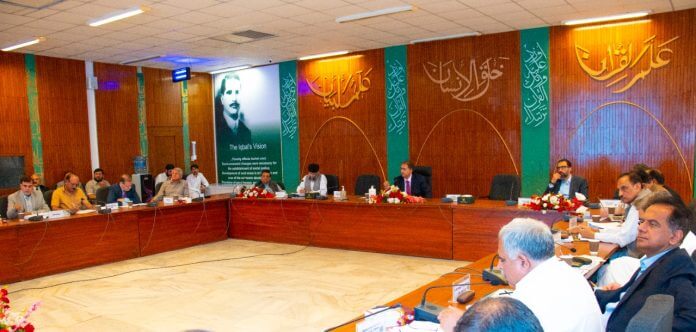
At the CDWP meeting, chaired by Planning Minister Ahsan Iqbal, concerns were raised over the results delivered by earlier foreign-funded programmes designed to strengthen tax administration.
A PIDE study cited during deliberations estimated that around $4.7 billion had already been obtained from development partners for tax system reforms.
The Revenue Division was asked to assess the impact and value for money of four major programmes — the Tax Administration Reforms Programme, Pakistan Single Window, Integrated Transit Trade Management System and Pakistan Raises Revenue Project.
Planning authorities also sought an assessment of existing facilities and previous reform interventions before further investment is undertaken.
The new project aims to help increase Pakistan’s tax-to-GDP ratio to 13.5% by 2029 from 11.1% at present, while expanding the taxpayer base and improving the efficiency of revenue administration.
The FBR told the meeting that TADRA was part of its 2024-28 Transformation Plan and would accelerate digitalisation across the tax administration system, improve taxpayer compliance and operational efficiency, and make customs clearance more transparent.
The Planning Commission, however, sought clarity on how the Rs57 billion project fits into the FBR’s broader Rs350 billion Transformation Plan already approved by the federal cabinet.
It asked the FBR to provide a matrix of measures under the transformation programme, including the implementation status of initiatives undertaken through previous, ongoing and proposed projects.
Iqbal called for clearly measurable outcomes linking the proposed financing to additional revenue collection, growth in the taxpayer base and improvement in the tax-to-GDP ratio.
The Planning Commission also sought a gap analysis, needs assessment and feasibility study, along with quantifiable results-based indicators and arrangements to sustain the project’s activities once financing ends.
Technical experts from the National University of Computer and Emerging Sciences and the National University of Sciences and Technology separately raised questions over data security, existing system capabilities and the artificial intelligence component proposed under the project.
They sought details on the basis of the proposed AI model as well as a comprehensive assessment of the systems that would be replaced or upgraded.
TADRA envisages a major expansion of the FBR’s data infrastructure, including increasing storage capacity from the existing 850 terabytes to three petabytes.
The additional capacity is expected to accommodate increased data generated through video-camera storage and processing systems on production lines across five major sectors, including sugar, cement, tobacco and textiles.
The proposed ADB financing carries a 25-year term, including a five-year grace period, with an annual interest rate of between 1.5% and 2%.
TADRA was one of two large projects referred by the CDWP to ECNEC at Friday’s meeting.
The second was the Rs37.2 billion PakSat-2 Satellite System, intended to replace PakSat-1R as the existing satellite approaches the end of its 15-year operational life later this year.
The CDWP had supported the project in principle in June while raising technical questions over plans for a sovereign and secure communications network serving at least 10,000 government users.
Related plans include the Rs709 million PAKAWAZ Secure Mobile Communication Ecosystem proposed by the National Telecommunication Company.
The system is intended to provide government users with secure audio and video calls, messaging, file and photo sharing and centrally controlled contact lists, supported by dedicated servers, mobile handsets and kill-switch controls.
It is designed around a private 4G LTE core network isolated physically or logically from the public internet to protect government communications and national data.
TADRA and PakSat-2 have a combined estimated cost of about Rs94.3 billion.
The CDWP separately approved five projects worth a combined Rs21.59 billion, taking the total value of projects cleared or recommended at the meeting to around Rs116 billion.
Among them was Rs5.015 billion for the second phase of a commercial olive cultivation programme, extending activities previously undertaken in Kallar Kahar, Islamabad and the wider Potohar belt to Balochistan and the New Merged Districts.
Another Rs6 billion was approved for the revised Dr Ashfaq Ahmad Khan Centre in Basic Sciences project covering eight national centres. Seven centres dealing with Artificial Intelligence, Cyber Security, Big Data and Cloud Computing, GIS and Satellite Technology, Automation and Robotics, Applied Mathematics, and Livestock and Genomics have already been completed.
The CDWP also approved Rs3.623 billion for the Development of Geospatial Complex, including a Geo-AI Development and Innovation Hub, and Rs5.758 billion for revamping facilities at the Pakistan Sports Complex in Islamabad.
A Rs338.179 million project to improve the high-frequency radio network of WAPDA’s Water Resources Management Directorate was also cleared.