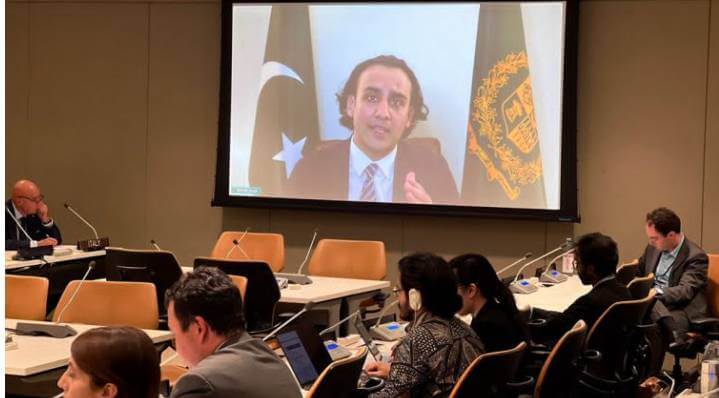
ISLAMABAD: Minister of State and Chairman of the Pakistan Virtual Assets Regulatory Authority (PVARA) Bilal Bin Saqib has called on UN member states to strengthen regulatory and institutional frameworks for digital assets and the next generation of global finance.
Addressing a United Nations Headquarters session virtually on “Digital Assets and Blockchain for Sustainable Development: Advancing Digital Finance through Innovation”, Bilal Bin Saqib said digital assets, tokenization and distributed ledger technologies could offer emerging economies new ways to improve financial inclusion, efficiency and access.


The session was convened by Pakistan’s Permanent Mission to the United Nations in collaboration with the UN Development Programme (UNDP), UN Trade and Development (UNCTAD) and the Office of the Secretary-General’s Envoy on Technology (ODET).
“The question before this room is not whether these technologies will scale. They will. The question is: who will shape them, and in whose interest?” Bilal Bin Saqib said.
He highlighted the estimated 1.4 billion adults worldwide who remain outside the formal financial system, while noting that many others face barriers through costly remittances, slow settlement processes and limited access to credit.
Bilal Bin Saqib said the average cost of sending $200 in cross-border remittances remains more than twice the 3 percent target set under Sustainable Development Goal 10.c. Closing the gap, he said, could return billions of dollars annually to families.
The minister said the potential of digital finance extends beyond payments and remittances.
Identity and verifiable financial histories could help small businesses, farmers and women entrepreneurs demonstrate their economic activity without relying solely on conventional collateral or documentation.
He also pointed to tokenization as a potential means of mobilizing capital by fractionalizing assets, including infrastructure bonds and renewable energy projects. Distributed ledger technologies, he added, could improve transparency in public expenditure and supply chains.
At the same time, Bilal Bin Saqib cautioned against viewing technology as an automatic solution to financial challenges.
He cited risks including retail market volatility, illicit finance, concentration of power and widening regulatory disparities between countries.