ISLAMABAD: Pakistan and Bangladesh agreed to strengthen economic engagement and institutional cooperation while exploring opportunities to expand bilateral trade, investment and collaboration in managing energy supply challenges amid the evolving global crisis.
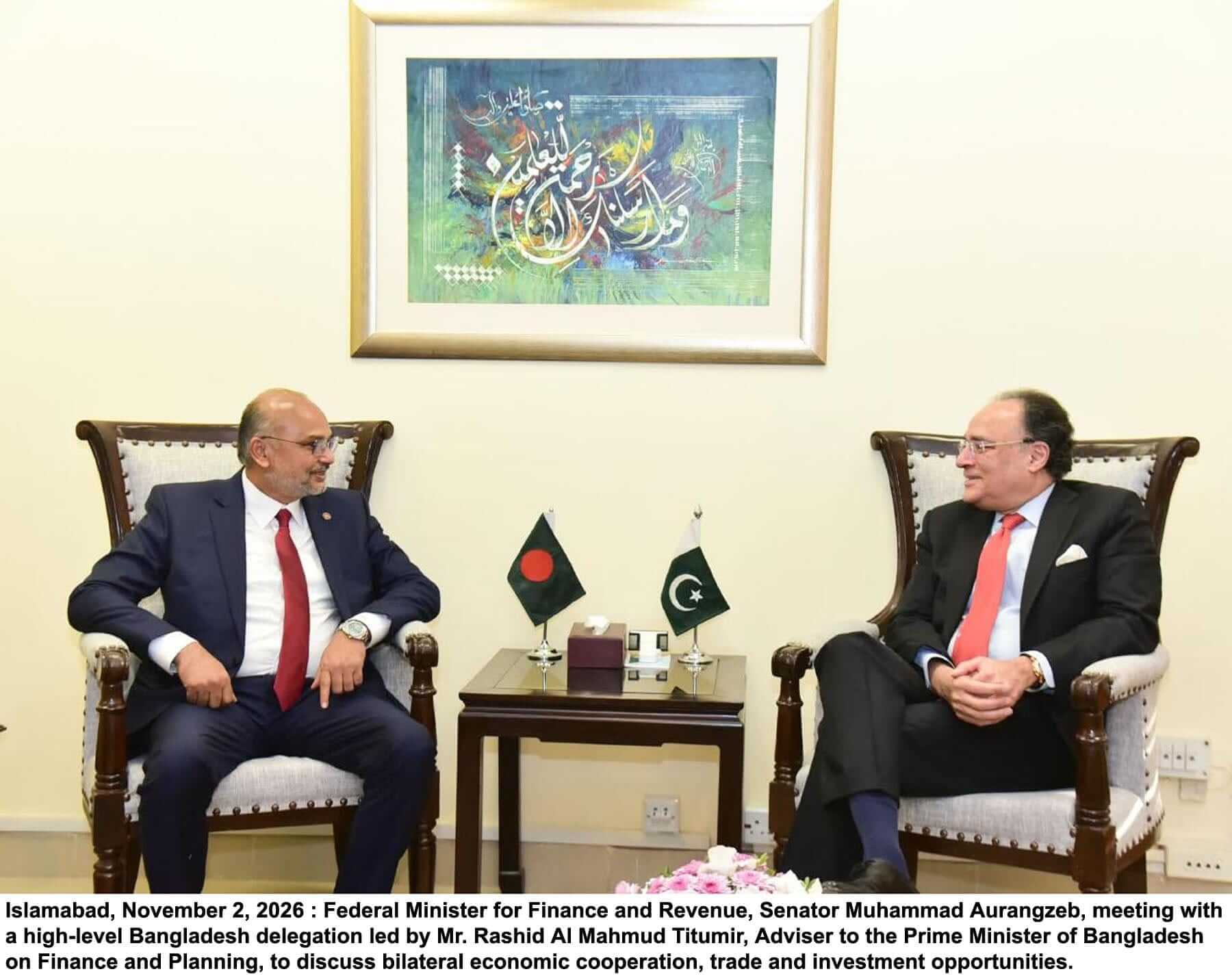
The understanding emerged during meetings between Finance Minister Senator Muhammad Aurangzeb and Petroleum Minister Ali Pervaiz Malik and a high-level Bangladeshi delegation led by Adviser to the Prime Minister on Finance and Planning Rashid Al Mahmud Titumir.


During his meeting with the delegation, Aurangzeb underscored the importance of closer economic ties and institutional exchanges, according to a Finance Ministry press release.
He shared Pakistan’s experience of macroeconomic stabilisation and structural reforms aimed at strengthening fiscal discipline, improving economic fundamentals and creating a conducive environment for private-sector investment.
The finance minister also highlighted the importance of prudent debt management, financial-sector development and sustained reforms in supporting long-term economic growth.
Welcoming the proposal for closer institutional engagement, particularly in public financial management and debt management, Aurangzeb expressed Pakistan’s willingness to share its experience and facilitate technical-level exchanges between relevant institutions of the two countries.
Titumir outlined Bangladesh’s economic priorities and reform initiatives, including efforts to attract investment, promote industrial development and generate employment.
Both sides exchanged views on the evolving global economic environment and the challenges facing developing economies, agreeing on the importance of maintaining macroeconomic stability while pursuing sustainable and inclusive growth.
Their discussions covered economic reforms, fiscal management, investment promotion and measures to strengthen economic resilience. They also explored opportunities for greater bilateral trade, investment, industrial cooperation and connectivity.
The two sides identified manufacturing, textiles and other areas of mutual economic interest as potential fields for closer collaboration, including through stronger links between their private sectors.
They reaffirmed their commitment to regular dialogue and continued exchanges of expertise to advance bilateral economic cooperation.
The visiting delegation included Bangladesh’s High Commissioner to Pakistan Iqbal Hussain Khan and Deputy High Commissioner Fazle Lohani Babu.
Energy security and supply challenges
Separately, Petroleum Minister Ali Pervaiz Malik held a meeting with Titumir to discuss the changing global energy situation, its impact on international markets and measures being taken by both countries to address supply challenges.
The two sides reviewed their respective strategies for ensuring uninterrupted fuel supplies and mitigating the economic impact of uncertainty in global energy markets.
Malik briefed the Bangladeshi adviser on Pakistan’s efforts to secure fuel supplies under challenging international conditions, as well as government initiatives, including targeted fuel subsidies, aimed at providing relief to consumers.
Titumir shared Bangladesh’s measures to ensure energy security and manage emerging supply challenges. He said the crisis had brought energy security to the forefront of policymaking and highlighted the need to make it a central consideration in national energy strategies.
He also stressed the importance of diversifying energy sources and supply routes to strengthen resilience against global disruptions.
The Bangladeshi adviser appreciated Pakistan’s diplomatic efforts to de-escalate the conflict involving Iran, saying a reduction in tensions was essential for global economic stability as the crisis continued to affect economies and energy markets worldwide.
He also commended Pakistan’s efforts to secure LNG cargoes from Qatar through the Strait of Hormuz despite difficult circumstances.
Malik described the situation as an unprecedented energy crisis, stressing the need for preparedness, diversification and regional cooperation to navigate global supply disruptions.
He expressed Pakistan’s willingness to share its experience and lessons with Bangladesh to support its efforts to manage the crisis and strengthen energy security.
Both sides underscored the importance of continued engagement and sharing of expertise to address common energy challenges and build greater resilience against future disruptions.