
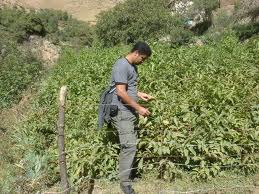
Officially the High Atlas Foundation’s director of programs in Marrakech, Ouarghidi, who focused his doctorate work on ethno botany and ecology in rural areas of Morocco and has worked with the Global Diversity Foundation, also advises additional HAF sites on issues like gardening and management. He meets regularly with funders, community leaders and HAF training workshop participants.
With this irregular, busy schedule, what keeps Ouarghidi going is his belief in HAF’s mission of helping rural communities develop themselves. As a scientist and development worker, he has a unique perspective both on preservation and community development.


“The object of being a scientist… is always to preserve resources,” said Ouarghidi. “Being a development agent, you always think about developing the community over the resources. If you’re in the middle, you can… (think) about the preserving and conserving of all the resources, but also (think) about how that can be balanced with developing the community. That’s the position I want to be in the middle, that I can bridge both sides.”
To fulfill this goal, he feels he must be available to local counterparts at all times.
“With (development) work, you can’t say after six o’clock that you’re done,” said Ouarghidi. “People might call you at 12. People might call you at five o’clock in the morning… you’re working 24 hours. Whenever people get stuck or there is an issue… they need to reach you. You cannot anticipate things.”
This availability, says Ouarghidi, creates more than an efficient partnership: it also lays the foundation for long-lasting bonds between HAF and its rural partners.
“We’re seeking to be close to the community. We’re seeking to be participatory, because (local counterparts) know that they can participate. They know that we’re giving them the chance and a place to express themselves, to make their own decisions, then realize their projects.”
For Abderrahim, this empowerment has also lead to deep friendships.
“People, when they love you, they really love you,” said Ouarghidi. “(This job is) something that you do with love. (Local counterparts) want you… they know that you are the solution (to certain problems.)”
Ouarghidi’s effectiveness may stem from his own ties to rural life. Ouarghidi, who is of mixed Arab and Amazigh descent, spent childhood summers in the mountains near Marrakech, where he learned Tachelhit. This connection gave him insight into the lives and struggles of rurally based Moroccans.
“Being in the mountains and seeing people’s struggles and difficulties and going to these fields, you know what people are facing because you’ve been there, and you know exactly what’s happening,” said Ouarghidi. “You know how to get connected to them, and to be connected to their problems, to their priorities.”
In the future, Ouarghidi hopes to focus on how water management affects rural gender empowerment.
“I was fortunate in life. I had a great education, great opportunity. My duty is to give, because I have lots that I have to give.”
This year, HAF has planted 320,000 organic fruit trees at 94 rural schools and community nurseries across Morocco.
Ida Sophie Winter is an undergraduate student of journalism at the University of Missouri. Currently, she is attending Al Akhawayn University in Ifrane as a Boren Scholar.



