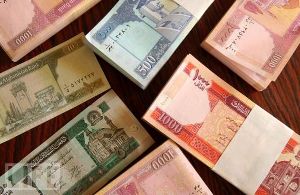
KABUL: The Afghan currency lost its value by 11 percent against the US dollars and the Pakistani rupee in the past four months, when rates of food items and other commodities increased by 18 percent and fuel by 40 percent.
In 2003, when new banknotes were printed for the first time when, one US dollaraccounted for 48 afghanis. Later, the greenback rose in value, selling for 52 Afghanis. But the currency has deprecated in the past two years.


Moneychangers said on Sunday the buying rate of one US dollar was 68.50afs while 1,000 Pakistani rupees accounted for 636afs. On July 2, the buying rate of one US dollar was 60.50afs and 1,000 Pakistani rupees 584afs.
Statistics show the value of the local currency has fallen by 13 percent against the dollar and nine percent against the rupee. However, the rates of food and other daily-use items have continually soared.
Ghulam Sakhi, a worker of the Shahr-i-Ara filling station in Kabul, sold one litre of petrol for 51afs and the same quantity of diesel for 42afs. But four months back, one liter of petrol cost 48afs and the same quantity of diesel 41afs.
Mohammad Sharif, a liquefied gas seller in Kolola Pushta area, sold a kilogram of the commodity for 65afs, comparedwith 30afs four months ago.
Officials at the Ministry of Commerce and Industriessay they will shortly import 372,000 tonnes of liquefied gas from Azerbaijan, Russia and Turkmenistan. The gas price will thus fall automatically, they hope.
Food Traders Union head Fazal Rahman says the price of a 49 kilograms bag of Pakistani flour was 1,460afs and the same quantity of sugar 2,120afs.A 24.5kg bag of rice cost 1,750afs, a 16-litre tin of ghee 1,000afs, a kilogram of green tea 210afs and the same quantity of African black tea 240afs.
In Julythis year, a 49kg of Pakistani flour cost 1,230afs, the same quantity of sugar 1,620afs, a 24.5kg sack of rice 1,550afs, 16 litres of ghee 950afs, a kilogram of green tea 180afs and the same quantity of black tea 210afs.
Dealers tie the increase in commodities’ rates to the weakening of the currency.However, a number of Kabul residents grumble rates of daily-use goods have soared uncontrollably. The currency has also been allowed to witness a free fall.
Ahmad Khalid, a resident of Dahn-i-Bagh area, said: “Keeping in view the afghani-dollar equation, prices of food items have gone up immensely. There has to be an organisation to regulate these rates.”
Ministry of Rural Rehabilitation and Development (MRRD) Khalid, who purchased a bag of flour for 1,550afs this morning, said it was difficult for a government servant satisfying all family needs due the unprecedented price hike. His monthly salary is 8,000 afghanis (116 US dollar).
Shukuria, a resident of Taimani neighbourhood, complained of economic problems and the government’s lethargy toward people’s plight. “My husband is a teacher with a 9,000 afghanis salary. It is very difficult for him to feed all his seven member family.”
She called for the government to control the rates of essential commodities and try to stabilise the currency. The ordinary people were the worst-hit by the present situation, she said, accusing market forces of exploiting consumers.
But Khair Mohammad Safdari insisted: “The Kabul Municipality has no right to define or control rates based on the cabinet decision in a free market system,”Based on Article 10 of the constitution, thegovernmentshould encourage, protect as well as ensure the safety of capital investment and private enterprises in accordance with the provisions of the law and the market economy.