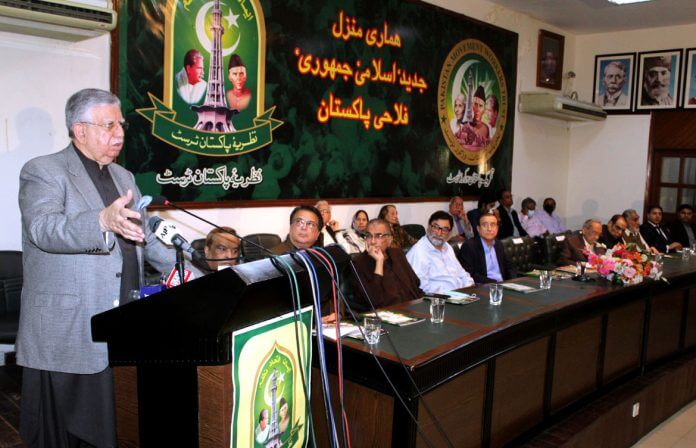
LAHORE: Federal Finance Minister Senator Shaukat Tarin said on Friday that Pakistan Tehreek-e-Insaf (PTI) government had introduced various initiatives for inclusive and sustainable economic growth by focusing on empowering youth/ common man, industrial expansion, increased agricultural yield, institutional reforms, increased revenue collection, broadening of tax base, and narrowing down the import-export gap.
He said that during a recent visit to China, Pakistan had asked the Chinese authorities that it wanted support in four major areas, which would lead to speedy socioeconomic growth. “With your (Chinese) support, we have established infrastructure, connectivity and SEZs (Special Economic Zones). Now we want you to help us in populating these SEZs,” the all-weather friend was informed.

“Help us in agricultural development and research; support us in IT sector development as five Special Technology Zones are being established in Pakistan; and the last but not least, it (China) should help maintain trade balance with Pakistan,” he added.
He expressed these views while addressing a seminar titled ‘Revival of Pakistan’s economy and outlook in 2022’ here at Aiwan-e-Karkunaan-e-Tehrik-e-Pakistan, where Nazria Pakistan Trust Chairman Mian Farooq Altaf delivered the welcome address.
While, Tehrik-e-Pakistan Workers Trust Chairman Justice (retd) Mian Mahboob, SAARC Chamber’s President Iftikhar Ali Malik, Lahore Chamber’s Senior Vice President Rehman Aziz Chan, Vice President Haris Attique, senior journalist Mujeebur Rehman Shami, Millat Group Chairman Sikandar Mustafa, students and people from various walks of life attended the event.
Since inception of Pakistan, the country’s economy had been witnessing ups and downs, and could not achieve economic stability and continuous upward growth due to various reasons, the finance minister said and recalled that Pakistan had been achieving fast economic growth in 1960s due to effective planning and financial management, and its growth rate was double than even South Korea, Saudi Arabia and Thailand.
But in 1970s, the then government took a wrong turn by nationalising the industry, financial and insurance sectors due to which country’s 5 to 6 per cent growth rate had declined gradually. And in 1979, Pakistan took another bad decision of getting into Afghan war that was not ours, and consequently, our socioeconomic fabric was jeopardized.
During 1980s, Pakistan also could not benefit from global economic boom, as there had been martial law here, while Taiwan, Singapore and Hong Kong took advantage of it, he said, asserting that in the second such economic wave, Malaysia, Indonesia and Philippine etc. improved their economies.
Elaborating further, the finance minister mentioned that Pakistan witnessed an artificial economic growth rate during Musharraf regime, but soon after his government, the country’s economy dwindled in one go and the country had no other option but to go to the IMF (International Monetary Fund).
Tarin said that the PTI government had not only pointed out the factors affecting the economic growth, but also taking effective measures and focusing long-term planning to ensure economic stability as well as improved growth rate.
He said that in January 2021, petrol price was USD 42 per barrel, and today it has reached USD 118, and with the current global POL [petroleum, oils, lubricant] prices, petrol price in Pakistan should be Rs 240 per liter, but the government fixed it at Rs 150 bearing a hefty loss of Rs 104 billion per month. Similarly edible oil price was USD 400, but today its USD 1,734.
Soon after coming to power, he said, the PTI government rebased the country’s economy and managed to bring growth rate at 6.3 per cent, but invasion of coronavirus pandemic obstructed our growth rate.
However, Pakistan growth rate slightly lowered to 5.6 per cent due to selected lock-downs and better financial management by the government under the vision and guidance of Prime Minister Imran Khan.
The federal finance minister said that the PTI government was leading country’s economy towards inclusive and sustainable growth that will have positive trickle-down effects for which the common man has been looking for decades, as the price-hike has affected majorly of the urban middle and lower middle as well as the salaried class the most.
“We have made better planning to ensure trickle-down effect and launched Kamyab Naujawan Programme under which a total of Rs 50 billion small loans have so far been given to the youth for starting their own business and getting on their feet.
Similarly, we have resolved the major problems of medical/ health expenses of the common man by introducing Sehat Insaf Card, giving medical treatment facilities up to Rs 1 million per family per year in all public and private hospitals,” he cited.
Under the Kamyab Naujawan Programme, soft loans of Rs 2.4 trillion would be given to the youth in the next five to seven years that will definitely enable those young males and females looking for a job, to be employers.
Shaukat Tarin said that Pakistan’s economic indicators were positive but those were overshadowed by super circle of price hike across the world. As soon as this super circle would end, our economy would be growing at faster pace.
The government is taking steps to increase industrial productivity through long-term planning, reforming the tax collecting institutions including FBR and Customs, and broadening the tax base having only three million taxpayers, out of 220 million population, which is very unfortunate, he added.
The PTI government, he added, also focused on major economic sectors of housing, energy, IT, agriculture, besides strengthening the formal financial institutions.