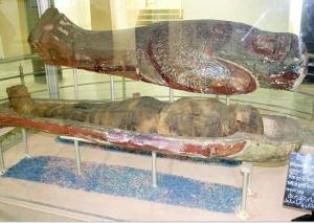
MALI: Researchers studying two ancient Egyptian mummies, dating back to some 3,500 years, have found that they were embalmed with unusual recipes whose components had anti-bacterial and anti-insecticidal properties.
Researchers investigated the 18th Dynasty mummies of the royal architect Kha and his wife Merit, a couple who were believed to have undergone a short and poor mummification despite their relative wealth at death.
Their internal organs had not been removed and placed in canopic jars, as generally occurs in classical royal 18th Dynasty artificial mummification.
But all internal organs – brain, thoracic and abdominal organs, eyeballs as well as ocular muscles and nerves — were in excellent state of preservation after some 3,500 years.


“Both individuals underwent a relatively high quality of mummification, fundamentally contradicting previous understanding,” researchers said in the journal PLOS ONE.
“Elucidated ‘recipes,’ whose components had anti-bacterial and anti-insecticidal properties, were used to treat their bodies,” the researchers added.
The tomb of Kha and Merit was discovered by the Italian Egyptologist Ernesto Schiaparelli in 1906 on the cliffs surrounding the ancient village of Deir el-Medina.