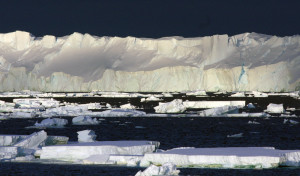
ANTARCTIC: New mapping of one of the most remote areas in Antarctica has revealed regions deep within Earth’s largest ice sheet that are particularly prone to rapid melting.
Our study, published today in Nature, is focused on East Antarctica’s Totten Glacier, the outlet for the world’s largest ice catchment. The results suggest that if rising global temperatures trigger the glacier to retreat rapidly – as has happened previously in its history – this region alone could deliver sea-level rises of well over a metre over the ensuing centuries.

The Totten Glacier region is a key area for understanding the long-term vulnerability of the Antarctic Ice Sheet, but until now, knowledge of this region’s glacial history has been very limited.
Our study shows that, although the region near the coast is quite stable on timescales of several millennia, regions further inland have potential for significant and rapid retreat as the climate warms.
Specifically, we identified two stable zones where the ice sheet is not prone to rapid collapse, and two unstable zones, where it is. We have also discovered that transitions between these states have happened repeatedly during the life of the ice sheet.
As part of the international ICECAP project, my colleagues and I used ice-penetrating radar, as well as magnetic and gravity data, to chart the rocks beneath the glacier.
By mapping the shape of the ice-sheet and its base, as well as the thickness of the rocks and sediments beneath, we were able to study the characteristic patterns of erosion left behind by the ice sheet’s previous advances and retreats – thus revealing the ice sheet’s past behaviour.
The observed patterns suggest that the ice sheet has spent much of its history in one of two configurations: either the edge has been close to the current Antarctic coast (within 150 kilometres); or it has been located some 350-550 kilometres inland. In either of these states, the ice would be relatively stable, with this glacier providing sea level fluctuations of less than a metre over the course of glacial cycles.
But the pattern of erosion also shows that melting has periodically forced the ice sheet out of either of these stable states, causing the ice sheet to collapse and retreat far inland. These events might have typically driven up global sea levels by 1.3-1.4 metres over the course of a few centuries.
Main image: present-day configuration of the Antarctic ice sheet surface and its base. The ice sheet surface is shaded according to surface velocity, with glaciers in red. Blue-cyan tones indicate where the ice-sheet base (or the sea floor) is below sea level, yellow-brown tones indicates where the ice sheet base is above sea level. Inset diagrams show reconstructions of the ice sheet and the coast following retreat driven by climates warmer than today’s. All images are vertically exaggerated. (Source: ICECAP Collaboration)
Previous studies from satellite data have indicated that the coastal part of the Totten Glacier region and its floating ice shelf are melting rapidly. Last year, the ICECAP team discovered that there is currently warm water circulating underneath a floating portion of the glacier that is causing more melting than might have been expected.
Our results show that following a rapid loss of coastal ice due to the collapse of the floating ice shelf, this region is likely to respond more slowly than other parts of Antarctica to warming temperatures, due to the existence of a “stable zone”.
But as temperatures continue to increase, this glacier is likely to retreat into the unstable zone, and make a rapid and proportionally greater contribution to sea levels.
Our ice sheet modelling suggests that while the Totten region is not the first region in Antarctica to respond to warming climate, it is likely to become progressively more unstable as warming proceeds over hundreds to thousands of years. Ultimately this region could become the “fat end of the wedge” in terms of Antarctica’s overall contribution to rising seas, accounting for almost 15% of Antarctica’s total contribution to sea-level rise. This is likely to happen while other regions have become ice-free, or are stabilising after periods of rapid ice loss.
Impact of the Totten Glacier’s retreat on the Antarctic’s overall contribution to sea-level rise. The unstable retreat events in the Totten Glacier region cause significant upwards deviations of the overall Antarctic trend. (Source: Author provided)
Our results suggest that the Totten region has severe implications for global sea level rise in warming climate conditions, especially once warming reaches the critical thresholds likely to tip the glacier out of its stable states. Given the long timescales involved for ice-sheet melting it is difficult to say with confidence when this tipping point might be reached.
Increases to carbon dioxide levels today will commit us to temperature increases that persist for thousands of years. The upper limit of the coastal stable zone could be crossed under conditions similar to those predicted for the next century, based on the higher emissions scenarios envisaged by the Intergovernmental Panel on Climate Change.