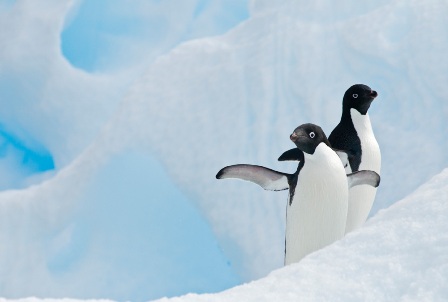
LONDON: Species of Antarctic penguins are facing a challenge from climate change. It appears that one is taking on the challenge better than the other. While Gentoo penguins are increasing in number, Chinstrap penguins are becoming fewer.
Over time, the two species have adapted to co-exist and share the food supply, but confronted by the most dramatic impact of global warming anywhere on the planet, Chinstrap penguins are paying the price for being picky eaters, according to a new study from Louisiana State University (LSU).


“Our data shows Gentoo penguins have a more diverse and flexible diet than Chinstrap penguins, which forage farther offshore and preferentially feed on Antarctic krill during the breeding season,” said LSU Department of Oceanography and Coastal Sciences Assistant Professor Michael Polito.
In 2012, Discovery reported that more than one-third of the breeding colony of Chinstrap penguins has been lost in the past 20 years.
The diverse feeding methods of the two species are thought to have developed so that they did not tread on each other’s three little toes, but the Chinstraps may now have to emulate the methods of Gentoos.
Antarctic krill make up the traditional diet of both types of penguin. Krill rely on sea ice, which is rapidly becoming less with a yearly average temperature increase of about 5 degrees Fahrenheit (2.8 degrees Celsius). The shrimp-like crustaceans use sea ice for protection from predators while they feed on algae growing beneath it.
“For a region that for most of the year hovers around the point of freezing, a few degrees plus or minus is the difference between freezing and melting, particularly of sea ice,” Polito said.
In the past, the Chinstraps’ habit of looking in places with large, predictable patches of krill offshore made sense, but they appear unwilling to deviate from that plan even though changing conditions make it less viable. Gentoos are more willing to change their diet, and even move to different areas to breed. They are also thought to ease the transition of their chicks into adulthood by feeding them for a longer period of time, according to LSU researchers.