Customs Today
  • Home
  • Islamabad
  • Karachi
  • Lahore
  • National
  • Transfers and Postings
  • Chambers & Associations
  • Business
No Result
View All Result
Customs Today
  • Home
  • Islamabad
  • Karachi
  • Lahore
  • National
  • Transfers and Postings
  • Chambers & Associations
  • Business
No Result
View All Result
Customs Today
No Result
View All Result
Home Science & Technology Science

Ants can smell a friend from a foe, study

byCustoms Today Report
18/08/2015
in Science, Science & Technology
Share on FacebookShare on Twitter

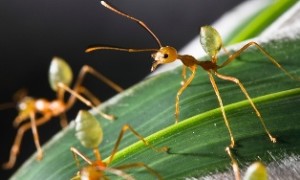
WASHINGTON: Ants use their powerful sense of smell to distinguish intruders from safe fellow-ants in their colonies, scientists, including those of Indian-origin, have found.

Scientists at the University of California, Riverside have found that ants communicate using a number of hydrocarbon chemicals present on their cuticles (their outer shells).


You might also like

Tesla driverless system to use updated radar technology

12/09/2016

Apple to develop its own self-driving technology

10/09/2016

The researchers noted that ants, which have evolved some of the largest families of olfactory receptor genes in insects, use their powerful sense of smell to sense the chemicals present on the cuticle of individuals to precisely identify the different members of their society.

“Until now, very little was understood about how ants use olfactory detection of pheromones to recognise individuals belonging to different castes or different colonies in their societies,” said Anandasankar Ray, from the University of California, Riverside in US who led the research team.

“To address this problem, we decided to focus our attention on the worker ants’ antennal neurons and their responses to hydrocarbons on the cuticle,” said Ray.

Ray, who is also the director of the Centre for Disease Vector Research at UC Riverside, was joined in the study by Kavita R Sharma of UC Riverside.

Ray’s team applied a powerful electrophysiology method, to test hydrocarbons present on the worker and queen cuticles that have previously been suspected to act as pheromone cues.


Related Stories

Tesla driverless system to use updated radar technology

byCT Report
12/09/2016

WASHINGTON: Electric carmaker Tesla announced Sunday it was upgrading its Autopilot software to use more advanced radar technology. In a...

Apple to develop its own self-driving technology

byCT Report
10/09/2016

SAN FRANCISCO: Apple may not become an automaker, but it still wants to develop its own self-driving technology. The iPhone-maker's...

NASA spots slowest known magnetar

byCT Report
10/09/2016

WASHINGTON: Astronomers have found evidence of a magnetar - magnetised neutron star - that spins much slower than the slowest...

‘YouTubers’ outshining old-school television

byCT Report
09/08/2016

SAN FRANCISCO: A media revolution is taking place, and most people over 35 years of age aren’t tuned in. Millennial...

Next Post

Hong Kong stocks slump 0.74% at end of trade

  • Terms and Conditions
  • Disclaimer

© 2011 Customs Today -World's first newspaper on customs. Customs Today.

No Result
View All Result
  • Transfers and Postings
  • Latest News
  • Karachi
  • Islamabad
  • Lahore
  • National
  • Chambers & Associations
  • Business
  • About Us

© 2011 Customs Today -World's first newspaper on customs. Customs Today.