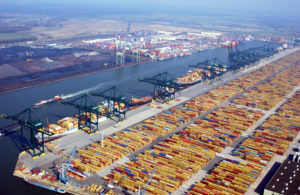
WASHINGTON: The European waterfront is looking forward to a boring 2017 as the market slide has bottomed out with leading ports posting modest growth or at least stabilizing traffic after several quarters of decline that threatened to become the norm. Antwerp was the star performer in 2016, with above-average market growth that saw Europe’s second-largest container hub narrow the gap with leader Rotterdam and pull further ahead of third-ranked Hamburg, a trend that looks as if it will continue this year.
The Belgian port has finally put to rest the myth that its inland location would cripple its ability to handle the latest generation of mega-ships and steadily lose ground to its rivals in the dominant Le Havre-Hamburg range. Despite snail’s-pace growth on the key Asia-North Europe trade lane, Antwerp boosted traffic by 4 percent in the first nine months of 2016, to nearly 7.6 million 20-foot-equivalent units, putting it on course for a second consecutive record year that would breach the 10 million-TEU barrier. This follows 7.5 percent growth in 2015, to more than 9.6 million TEUs. Rotterdam’s traffic slipped 0.4 percent in the first three quarters to 9.3 million TEUs, but this was largely due to declines in the first five months. Since then, volume has grown, and it was expected to accelerate in the final quarter of 2016 as its two new automated terminals iron out their teething problems. Underscoring the Dutch port’s position as the top Asia-Europe hub was the acquisition by China’s Cosco group of a 35 percent stake in the Euromax terminal from Hong Kong’s Hutchison Port Holdings.

Hamburg has finally pulled out of an extended slump that reduced its container traffic by 9.3 percent in 2015. Volume was essentially flat through much of 2016, at 6.7 million TEUs in the first nine months, thanks to a long-awaited recovery in Asia trade, which was up 1 percent year-over-year. Equally significant, the key Russia feeder trade that has been in freefall because of the country’s economic woes also rebounded, with traffic rising 4.4 percent to 337,000 TEUs despite continuing Western sanctions against the Kremlin. And 2017 could be an even better year as the German Federal Court is expected to approve the long-delayed deepening of the river Elbe, Hamburg’s 38-mile link to the open sea, which will boost its competitive position in the north European port range as mega-ships will be able to take on an extra 1,800 20-foot containers per visit. Despite Europe’s sluggish economic growth, its second-tier ports continue to invest in a bid to lure traffic from the market leaders. DCT Gdansk, Poland’s largest container terminal, opened its second deep-water berth in October, doubling its annual capacity to 3 million TEUs and improving its ability to attract long-haul Baltic-bound traffic. A month later, Liverpool inaugurated a new $500 million deep-water terminal, its second, as it bids to lure traffic away from the UK’s dominant southern ports that account for the bulk of shipments from Asia destined for the north of the country. The northwestern port’s long-term aim is to capture a 15 to 20 percent market share, up from 8 percent currently.
Meanwhile, state-of-the-art terminals planned in the double-digit growth era before the 2008-2009 global financial crisis, are boosting traffic steadily, but not fast enough to throw off their “white elephant” image. The 4-year-old Jade Weser terminal in Wilhelmshaven, Germany’s only deep-water port, boosted traffic more than 26 percent to almost 412,000 TEUs in the first nine months of 2016, but remains far short of its 2.7 million-TEU annual capacity. DP World regularly cites London Gateway among the terminals seeing increased volumes, but it has yet to attract a major east-west service. Southern Europe, meanwhile, continues to make headlines, as outsiders move in to exploit the region’s potential. The acquisitive Cosco group won control of Piraeus, Greece’s top port, which it has transformed into a major regional transshipment hub for south and southeast Europe since it obtained an operating concession for two terminals in 2009. One of the biggest success stories in the Mediterranean was the revival of Gioia Tauro, Italy’s leading transshipment hub, which boosted traffic 8.4 percent in the first nine months of 2016, to more than 2 million TEUs, and also raised handling rates as a restructuring and cost-cutting program began to pay off. The double-digit days of growth are long gone and unlikely to return, but the European waterfront looks as if it has shaken off the threat of an extended bear market. That’s progress as 2017 begins.