You might also like


FRANCE: A 16-year-old French volunteer archaeologist has found an adult tooth dating back around 560,000 years in southwestern France, in what researchers hailed as a “major discovery” Tuesday. “A large adult tooth – we can’t say if it was from a male or female – was found during excavations of soil we know to be between 550,000 and 580,000 years old, because we used different dating methods,” paleoanthropologist Amelie Viallet told AFP. “This is a major discovery because we have very few human fossils from this period in Europe,” she said. The tooth was found in the Arago cave near the village of Tautavel, one of the world’s most important prehistoric sites which has been excavated for about 50 years.
It is also the site of the discovery of over 140 fossils belonging to Tautavel Man, an early hominid that lived an estimated 450,000 years ago.
Volunteer Camille, 16, was working with another young archaeologist when she found the tooth last Thursday. They were among the hundreds of young trainee archaeologists who come to work in the cave every year to study human ancestors during the lower Paleolithic era, when they first began to use tools. The owner of the tooth – a very worn lower incisor – lived during a cold, dry and windy period and according to archaeological finds in the cave, hunted horses, reindeer, bison and rhinoceros.
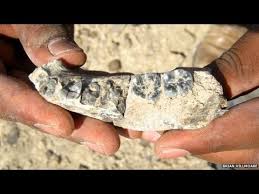
For a long time the Heidelberg jaw – including the chin and full set of lower teeth – discovered in Germany in 1907 dating to around 600,000 years ago, was the oldest fossil of human ancestors in western Europe. However some archaeological sites offered up evidence of stone tools dating back much earlier. This has left many questions and stirred debate about the life and presence of human ancestors in Europe before modern humans rose out of Africa and went on to conquer the planet.
In 2013 the discovery of a fossil tooth in southeastern Spain that dated to about 1.4 million years ago shook up the timeline of the colonisation of Europe by modern humans. Dr Matthew Skinner, a palaeoanthropologist from the University of Kent in Britain said that while the find was important as there are few human fossils from this period, “a single tooth, I wouldn’t say is a major discovery, unfortunately.”
“If there’s something about its shape or its size that would suggest that it is different from the other fossils we have from that time period and perhaps belongs to a different species , then that would be of course very interesting.”He said the most obvious species to which the tooth would belong would be Homo heidelbergensis – owner of the German jaw – about whom little is known. “These are certainly different from modern humans, they existed before Neanderthals. They had quite large brains and fairly complex behaviour but weren’t modern in the way that we are.