Customs Today
  • Home
  • Islamabad
  • Karachi
  • Lahore
  • National
  • Transfers and Postings
  • Chambers & Associations
  • Business
No Result
View All Result
Customs Today
  • Home
  • Islamabad
  • Karachi
  • Lahore
  • National
  • Transfers and Postings
  • Chambers & Associations
  • Business
No Result
View All Result
Customs Today
No Result
View All Result
Home Science & Technology Science

Arctic ice cap’s stunningly fast skate into the sea

byCustoms Today Report
26/01/2015
in Science, Science & Technology
Share on FacebookShare on Twitter

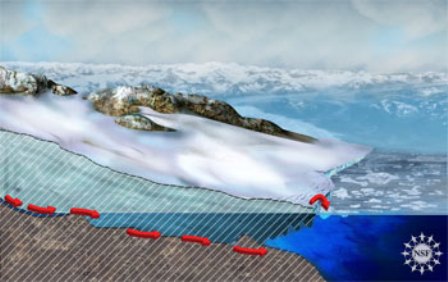
PERTH: For years, scientists have documented the fast retreat of Arctic ice, from dissolving glaciers in Greenland to shrinking snow cover in far northern Eurasia. Now researchers have exposed one Arctic ice cap that appears to be literally sliding into the sea.

Ice is disappearing at a truly astonishing rate in Austfonna, an expanse of frozen rock far north of the Arctic Circle in Norway’s Svalbard island chain. Just since 2012, a portion of the ice cap covering the island has thinned by a whopping 160 feet, according to an analysis of satellite measurements by a team led by researchers at Britain’s University of Leeds.


You might also like

Tesla driverless system to use updated radar technology

12/09/2016

Apple to develop its own self-driving technology

10/09/2016

Put another way, the ice cap’s vertical expanse dropped in two years by a distance equivalent to the height of a 16-story building. As another comparison, consider that scientists were recently alarmed to discover that one of Western Antarctica’s ice sheets was losing vertical height at a rate of 30 feet a year.

“It is a very large signal,” said Mal McMillan, a geophysicist and one of two researchers at Leeds’  Center for Polar Observation and Modelling who worked on the study. “The ice cap has slumped out into the ocean with a substantial loss of ice.”

McMillan and colleague Andrew Shepherd analyzed changes in Austfonna’s ice using data from satellites that measure, among other things, changes in elevation. They found that the gradual melting of the island’s 1,550-cubic-mile ice cap recently shifted into overdrive, for reasons that aren’t fully understood.  Small ice caps like the one over Austfonna are believed to be more vulnerable to climate change-related thawing because relatively more surface area is exposed to the air and sea.


Tags: Arctic iceSea

Related Stories

Tesla driverless system to use updated radar technology

byCT Report
12/09/2016

WASHINGTON: Electric carmaker Tesla announced Sunday it was upgrading its Autopilot software to use more advanced radar technology. In a...

Apple to develop its own self-driving technology

byCT Report
10/09/2016

SAN FRANCISCO: Apple may not become an automaker, but it still wants to develop its own self-driving technology. The iPhone-maker's...

NASA spots slowest known magnetar

byCT Report
10/09/2016

WASHINGTON: Astronomers have found evidence of a magnetar - magnetised neutron star - that spins much slower than the slowest...

‘YouTubers’ outshining old-school television

byCT Report
09/08/2016

SAN FRANCISCO: A media revolution is taking place, and most people over 35 years of age aren’t tuned in. Millennial...

Next Post

Rs55b burden on consumers: ECC okays raise in power tariff, 1.2m tonnes wheat export at Rs6b public expense

  • Terms and Conditions
  • Disclaimer

© 2011 Customs Today -World's first newspaper on customs. Customs Today.

No Result
View All Result
  • Transfers and Postings
  • Latest News
  • Karachi
  • Islamabad
  • Lahore
  • National
  • Chambers & Associations
  • Business
  • About Us

© 2011 Customs Today -World's first newspaper on customs. Customs Today.