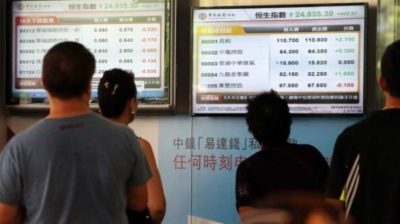
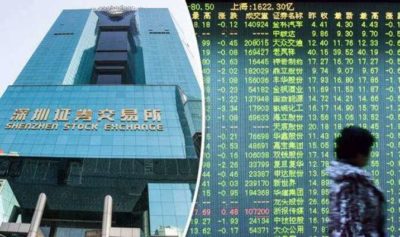
WASHINGTON: Asian markets traded mostly lower on Wednesday morning, as oil prices remained under pressure after data overnight showed a build-up in U.S. crude inventory. In Japan, the Nikkei Stock Average (Nihon Keizai Shinbun: .N225) fell 0.19 percent, while across the Korean Strait, the Kospi (Korea Stock Exchange: .KS11) was down 0.83 percent. Hong Kong’s Hang Seng Index (Hong Kong Stock Exchange: .HSI) was down 0.46 percent, while Chinese mainland shares were also lower. The Shanghai (Shanghai Stock Exchange: .SSEC) composite was down 0.37 percent and the Shenzhen (Dow Jones Global Indexes: .DJSZ) composite fell 0.29 percent.
Australia’s ASX 200 (^AXJO) bucked the generally downward trend in the region to trade up 0.24 percent, but the energy sector declined 0.86 percent. Oil plays in the country were mostly lower, with Santos (ASX:STO-AU) shares losing 1.16 percent, Oil Search (ASX:OSH-AU) down 0.65 percent and Beach Energy (ASX:BPT-AU) lower by 2.32 percent. Oil prices declined on Wednesday, extending Tuesday’s more than 1 percent drop after data showed a build-up in U.S. crude inventory. Reuters reported weekly data from the American Petroleum Institute (API) estimated U.S. crude stockpiles surged 14.2 million barrels last week. U.S. crude fell 1.17 percent to $51.56 a barrel by 10:58 a.m. HK/SIN on Wednesday, while global benchmark Brent lost 0.84 percent to $54.59. Some analysts had expected the decline in oil prices following the API numbers. “The herd, already nervous from the previous days price action, turned en masse and ran off the cliff,” Jeffrey Halley, a senior market analyst at OANDA, said in a note. Halley expects crude prices to remain under pressure. “Clearly increased shale production is now taking its toll,” he said, adding if the Energy Information Administration’s crude inventory numbers, due later in the global day, show a large build, prices could fall further.

Resources producer BHP Billiton (London Stock Exchange: BLT-GB) fell 0.71 percent, after reports said the miner planned to halt production at a Chilean copper mine due to a workers’ strike on Thursday. Reuters reported that BHP said it could not guarantee the safety of the 80 workers the Chilean government had authorized to remain at the Escondida mine to perform “critical duties” like equipment upkeep and adherence to environmental protocols. In the currency market, the dollar (STOXX:.DXY) traded relatively higher against a basket of currencies at 100.35 at 11:03 a.m. HK/SIN, climbing from levels below 100 in previous sessions. “Over the past few days…slowly but surely the dollar has managed to crawl its way back up,” said Rodrigo Catril, a currency strategist at the National Australia Bank, in a note. “To some extent, the dollar has won the least-ugly context as the focus appears to have shifted away from the U.S. towards political and fiscal uncertainty in Europe,” said Catril. Among other major currency pairs, the yen (:OSEJPY=) traded at 112.10 against the dollar, strengthening from levels above 113.4 last week. The stronger yen likely pressured Japanese exporters, with Toyota (Tokyo Stock Exchange: 7203.T-JP) shares down 0.30 percent, Mazda (Tokyo Stock Exchange: 7261.T-JP) down 1.35 percent and Sony (Tokyo Stock Exchange: 6758.T-JP) off by 1.33 percent. Fujitsu (Tokyo Stock Exchange: 6702.T-JP) shares declined 3.29 percent, after Reuters reported the electronic conglomerate’s biggest shareholder, Fuji Electric (Tokyo Stock Exchange: 6504.T-JP), planned to sell about $1 billion worth, or about 8.2 percent, of stock. Elsewhere, the Australian dollar (Exchange:AUD=) fetched $0.7635, while the euro (Unknown:EURBA=) traded at $1.0684.