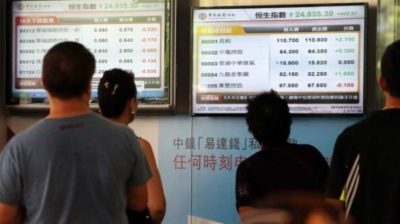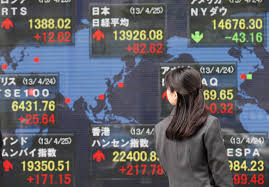
TOKYO: Asian stocks hardly budged on Monday on the first day of a new quarter while expectations of credit tightening by the world’s major central banks kept global bond markets under pressure. MSCI’s broadest index of Asia-Pacific shares outside Japan ticked down 0.1 percent, staying within a stone’s throw of its two-year peak hit last week. Japan’s Nikkei ticked up 0.2 percent while U.S. stock futures gained 0.2 percent. European stock futures opened higher, with Germany’s DAX futures up 0.6 percent, France’s CAC futures adding 0.9 percent and Britain’s FTSE futures advancing 0.4 percent.
Pan-European Euro first 300 stock index hit a 10-week low on Friday after the European Central Bank and the Bank of England last week signaled their readiness to tighten their monetary policies. “Up until recently, only the Fed was tightening its policy. If the ECB is also jumping on to this, that is huge. We can’t take this lightly,” said Arihiro Nagata, head of derivatives at SMBC Nikko Securities. Global bond yields have risen sharply following hawkish comments from European Central Bank President Mario Draghi last Tuesday, with German bond yields posting their biggest weekly jump since December 2015 last week. That helped to lift U.S. bond yields from lows, with the 10-year U.S. Treasuries yield hitting a 1-1/2-month high of 2.330 percent on Monday.
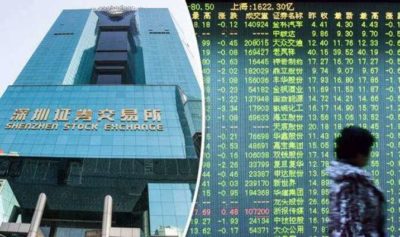
The uptick in European bond yields could encourage European investors, who have been pouring their money on higher U.S. yielding bonds, to put their money back in Europe. The rise in U.S. bond yields came even as data showed U.S. inflation cooled in May. The annual rise in core consumer prices excluding food and energy slowed to 1.4 percent, its lowest since December 2015. “In coming weeks, whether we can see a recovery in the U.S. momentum will be a key issue,” said Hirokazu Kabeya, chief global strategist at Daiwa Securities. On Wall Street, the S&P 500 scored its biggest gain for the first half of the year since 2013 while the Nasdaq Composite’s first-half gain was its best in eight years. Signs of stabilizing in China’s economy and a recovery in the European economy helped to boost global share prices in the first half of this year.
A private sector survey on China’s manufacturing showed a surprise recovery in activity, adding to the evidence of steadying growth in the world’s second largest economy. The Bank of Japan’s tankan corporate survey showed Japanese business sentiment improved slightly more than expected. In the currency market, the euro traded at $1.1405, not far from last week’s high of $1.1445, which was its highest level in more than a year as the common currency drew support from expectations that the ECB will likely scale back its stimulus.