


Customs Today
  • Home
  • Islamabad
  • Karachi
  • Lahore
  • National
  • Transfers and Postings
  • Chambers & Associations
  • Business
No Result
View All Result
Customs Today
  • Home
  • Islamabad
  • Karachi
  • Lahore
  • National
  • Transfers and Postings
  • Chambers & Associations
  • Business
No Result
View All Result
Customs Today
No Result
View All Result
Home Science & Technology Science

Astronomers are witness of high-energy cosmic fireworks set to occur in early 2018

byCustoms Today Report
08/07/2015
in Science, Science & Technology
Share on FacebookShare on Twitter

You might also like

Karachi Port sets 138-year cargo handling record

17/07/2026

Tesla driverless system to use updated radar technology

12/09/2016

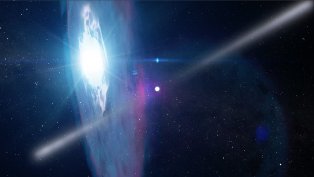
LONDON: Astronomers now prepare to witness high-energy cosmic fireworks set to occur in early 2018 when a city-sized stellar remnant encounters one of the Milky Way’s brightest stars.
The light show will happen when the pulsar, known as J2032+4127, or J2032, collides with its companion star. The pulsar, which was discovered by the Fermi Gamma-ray Space Telescope of the National Aeronautics and Space Administration (NASA), is the crushed core of a giant star that exploded as a supernova. The magnetized ball is about the size of Washington, weighs nearly twice the mass of the sun and spins seven times per second.
Although pulsars are often found through radio emissions, J2032 was detected through pulses of gamma rays, the most energetic form of light, using Fermi’s Large Area Telescope (LAT). Since J2032 was discovered, scientists have been monitoring it and noticed something peculiar.
University of Manchester physics professor Andrew Lyne said that they observed strange variations in the rotation and the manner at which the rotation of the pulsar slows down as these behaviors were not previously observed in other isolated pulsars.
Lyne said that they later realized that the oddities they have observed were caused by the pulsar’s motion around another star.
The massive star that tugs on J2032 was dubbed MT91 213 and is classified as a Be star. Such stars drive stellar winds and are embedded in large disks of dust and gas. MT91 213 is 15 times more massive than the sun and shines 10,000 times brighter.

Related Stories

Karachi Port sets 138-year cargo handling record

byCT Report
17/07/2026

KARACHI: Pakistan's maritime sector has achieved a major milestone as Karachi Port set a new record in its 138-year history...

Tesla driverless system to use updated radar technology

byCT Report
12/09/2016

WASHINGTON: Electric carmaker Tesla announced Sunday it was upgrading its Autopilot software to use more advanced radar technology. In a...

Apple to develop its own self-driving technology

byCT Report
10/09/2016

SAN FRANCISCO: Apple may not become an automaker, but it still wants to develop its own self-driving technology. The iPhone-maker's...

NASA spots slowest known magnetar

byCT Report
10/09/2016

WASHINGTON: Astronomers have found evidence of a magnetar - magnetised neutron star - that spins much slower than the slowest...

Next Post

Rosetta data revealed an irregular 'duck shaped' comet

  • Terms and Conditions
  • Disclaimer

© 2011 Customs Today -World's first newspaper on customs. Customs Today.

No Result
View All Result
  • Transfers and Postings
  • Latest News
  • Karachi
  • Islamabad
  • Lahore
  • National
  • Chambers & Associations
  • Business
  • About Us

© 2011 Customs Today -World's first newspaper on customs. Customs Today.