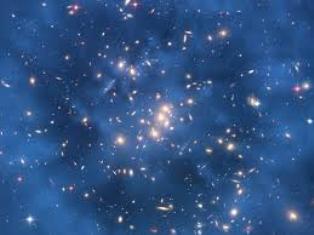
HONG KONG: A team of Japanese astronomers has used the European Southern Observatory’s (ESO) Atacama Large Millimeter/submillimeter Array (ALMA) to spot a group of huge, youthful galaxies in the distant Universe. The discovery helps us to understand the formation of such galaxies, and how they evolve into the elliptical galaxies we see today.
In comparison to earlier periods in its history, the modern Universe is a pretty tranquil place. Turn the clock back ten billion years and you’d find galaxies of monstrous proportions, with star formation rates hundreds or thousands of times that seen in the modern Milky Way. There aren’t any of these huge galaxies left in the modern era, but they didn’t simply disappear. Instead, scientists believe that they evolved into the giant elliptical galaxies we observe today.


In order to fully understand the evolution of these monstrous star forming galaxies, its essential that we get a good look at them – something that’s possible by peering into the distant reaches of the Universe, from where the light emitted 10 billion years ago is just now arriving at Earth.
Current theories suggest that such huge star forming galaxies formed in locations where dark matter is particularly concentrated, but up until now we’ve been unable to confirm this, with the objects routinely obscured by clouds of dust. The research team, which included two University of Tokyo professors, set out to locate the ancient galaxies, searching a group of objects known as SSA22 with the National Astronomical Observatory of Japan’s (NAOJ) Atacama Submillimeter Telescope Experiment (ASTE) telescope. The sensitivity of the instrument wasn’t enough to confirm the presence of the huge, highly active galaxies, but it did provide an indication that they might be present.
To delve deeper, the researchers then turned to ALMA, which is 10 times more sensitive and boasts 60 times the resolution of ASTE. With those capabilities, the team was able to confirm and pinpoint the location of nine galaxies.