Customs Today
  • Home
  • Islamabad
  • Karachi
  • Lahore
  • National
  • Transfers and Postings
  • Chambers & Associations
  • Business
No Result
View All Result
Customs Today
  • Home
  • Islamabad
  • Karachi
  • Lahore
  • National
  • Transfers and Postings
  • Chambers & Associations
  • Business
No Result
View All Result
Customs Today
No Result
View All Result
Home Science & Technology Science

Astronomers discover most distant object in solar system

bySana Anwar
02/12/2015
in Science, Science & Technology
Share on FacebookShare on Twitter

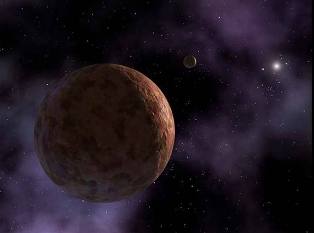
WASHINGTON: Astronomers have discovered what appears to be a miniature planet that is the most distant body ever found in the solar system, scientists said on Wednesday.

“We can’t really classify the object yet, as we don’t know its orbit,” said Scott Sheppard, an astronomer with the Carnegie Institution for Science in Washington, D.C. “We only just found this object a few weeks ago.”


You might also like

Tesla driverless system to use updated radar technology

12/09/2016

Apple to develop its own self-driving technology

10/09/2016

Based on its reflectivity, scientists believe the icy body, known as V774101, is between 300 and 600 miles (500 to 1,000 km) in diameter, roughly half the size of Pluto. It is almost 10 billion miles from Earth, or three times farther away than Pluto.

Currently, the most distant planet-like bodies in the solar system are Sedna, discovered in 2003, and VP113, discovered in 2012. At more than 80 times farther from the sun than Earth, the two are still closer than V774101, which is currently 103 times more distant from the sun than Earth.

Sheppard said it will take a year of observations to determine if V774101 travels into Pluto’s neighborhood, a region beyond Neptune known as the Kuiper Belt. This swath of space, which contains thousands of tiny planets, is 40 to 50 times farther away from the sun than Earth.

“If it never gets near Neptune that would make the object very interesting as its orbit would be unperturbed by the giant planets and thus allow us to understand the dynamics of the outer solar system,” Sheppard wrote in an email.

Sheppard is part of team that is conducting the most extensive search for distant bodies in the solar system.

“It is very much like looking for a needle in a haystack as the night sky covers a very large area that can only be searched one telescope pointing at a time,” Sheppard said.

The discovery was unveiled at an American Astronomical Society planetary sciences meeting in Maryland this week.


Related Stories

Tesla driverless system to use updated radar technology

byCT Report
12/09/2016

WASHINGTON: Electric carmaker Tesla announced Sunday it was upgrading its Autopilot software to use more advanced radar technology. In a...

Apple to develop its own self-driving technology

byCT Report
10/09/2016

SAN FRANCISCO: Apple may not become an automaker, but it still wants to develop its own self-driving technology. The iPhone-maker's...

NASA spots slowest known magnetar

byCT Report
10/09/2016

WASHINGTON: Astronomers have found evidence of a magnetar - magnetised neutron star - that spins much slower than the slowest...

‘YouTubers’ outshining old-school television

byCT Report
09/08/2016

SAN FRANCISCO: A media revolution is taking place, and most people over 35 years of age aren’t tuned in. Millennial...

Next Post

South Korean stocks weaker at noon, KOSPI declines 4.73pts

  • Terms and Conditions
  • Disclaimer

© 2011 Customs Today -World's first newspaper on customs. Customs Today.

No Result
View All Result
  • Transfers and Postings
  • Latest News
  • Karachi
  • Islamabad
  • Lahore
  • National
  • Chambers & Associations
  • Business
  • About Us

© 2011 Customs Today -World's first newspaper on customs. Customs Today.