Customs Today
  • Home
  • Islamabad
  • Karachi
  • Lahore
  • National
  • Transfers and Postings
  • Chambers & Associations
  • Business
No Result
View All Result
Customs Today
  • Home
  • Islamabad
  • Karachi
  • Lahore
  • National
  • Transfers and Postings
  • Chambers & Associations
  • Business
No Result
View All Result
Customs Today
No Result
View All Result
Home Science & Technology Science

Astronomers discover new transiting “circumbinary” planet

byCustoms Today Report
08/08/2015
in Science, Science & Technology
Share on FacebookShare on Twitter

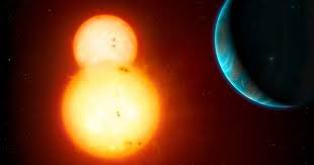
WASHINGTON: Astronomers at the 29th International Astronomical Union General Assembly will announce on August 14 the discovery of a new transiting “circumbinary” planet, bringing the number of such known planets into double digits. A circumbinary planet orbits two stars, and like the fictional planet “Tatooine” from Star Wars, this planet has two suns in its sky. The discovery marks an important milestone and comes only four years after the first Kepler circumbinary planet was detected. Once thought to be rare or even impossible, these ten discoveries confirm that such planets are common in our galaxy. The research was recently published in the Astrophysical Journal.

The new planet, known as Kepler-453 b, also presented astronomers with a surprising twist—the tilt of the orbit of the planet rapidly changes, making transits visible only 9 percent of the time. “The detection was a lucky catch for Kepler,” said William Welsh, professor of astronomy at San Diego State University and lead author of the study. “Most of the time, transits would not be visible from Earth’s vantage point.” The change of orientation of the planet’s orbital plane, known as precession, brought it into proper alignment halfway through the space telescope’s lifetime, allowing three transits to be observed before the end of the mission. “The low probability for witnessing transits means that for every system like Kepler-453 we see, there are likely to be 11 times as many that we don’t see,” added co-author Jerome Orosz, also a professor of astronomy at San Diego State University. The precession period is estimated to be approximately 103 years. The next set of transits won’t be visible again until the year 2066.


You might also like

Tesla driverless system to use updated radar technology

12/09/2016

Apple to develop its own self-driving technology

10/09/2016

Related Stories

Tesla driverless system to use updated radar technology

byCT Report
12/09/2016

WASHINGTON: Electric carmaker Tesla announced Sunday it was upgrading its Autopilot software to use more advanced radar technology. In a...

Apple to develop its own self-driving technology

byCT Report
10/09/2016

SAN FRANCISCO: Apple may not become an automaker, but it still wants to develop its own self-driving technology. The iPhone-maker's...

NASA spots slowest known magnetar

byCT Report
10/09/2016

WASHINGTON: Astronomers have found evidence of a magnetar - magnetised neutron star - that spins much slower than the slowest...

‘YouTubers’ outshining old-school television

byCT Report
09/08/2016

SAN FRANCISCO: A media revolution is taking place, and most people over 35 years of age aren’t tuned in. Millennial...

Next Post

Scientists developed heart shaped Li-ion battery

  • Terms and Conditions
  • Disclaimer

© 2011 Customs Today -World's first newspaper on customs. Customs Today.

No Result
View All Result
  • Transfers and Postings
  • Latest News
  • Karachi
  • Islamabad
  • Lahore
  • National
  • Chambers & Associations
  • Business
  • About Us

© 2011 Customs Today -World's first newspaper on customs. Customs Today.