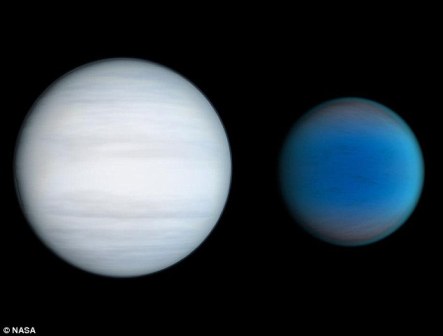
LONDON: A study by astrophysicists at the University of Toronto suggests that exoplanets outside our solar system are more likely to have liquid water and be more habitable than we thought.
The secret worlds are thought to exist beyond the orbits of Neptune, the furthest true planet from the Sun, and the even more distant tiny “dwarf planet” Pluto.


The evidence comes from observations of a belt of space rocks known as “extreme trans-Neptunion objects” (Etnos).
Orbiting the Sun beyond Neptune, Etnos should be distributed randomly with paths that have certain defined characteristics.
But a dozen of the bodies have completely unexpected orbital values consistent with them being influenced by the gravitational pull of something unseen.
Spanish lead scientist Professor Carlos de la Fuente Marcos, from the Complutense University of Madrid (UCM), quoted by the Spanish scientific news service, said: “This excess of objects with unexpected orbital parameters makes us believe that some invisible forces are altering the distribution of the orbital elements of the Etno, and we consider that the most probable explanation is that other unknown planets exist beyond Neptune and Pluto.
“The exact number is uncertain, given that the data that we have is limited, but our calculations suggest that there are at least two planets, and probably more, within the confines of our solar system.”
Astronomers have spent decades debating whether a hidden planet beyond Pluto remained undiscovered.
The new research, published in the journal ‘Monthly Notices of the Royal Astronomical Society Letters’, is based on analysis of an effect called the “Kozai mechanism”, by which a large body disturbs the orbit of a smaller, more distant object.
The scientists wrote: “In this scenario, a population of stable asteroids may be shepherded by a distant, undiscovered planet larger than the Earth…”