Customs Today
  • Home
  • Islamabad
  • Karachi
  • Lahore
  • National
  • Transfers and Postings
  • Chambers & Associations
  • Business
No Result
View All Result
Customs Today
  • Home
  • Islamabad
  • Karachi
  • Lahore
  • National
  • Transfers and Postings
  • Chambers & Associations
  • Business
No Result
View All Result
Customs Today
No Result
View All Result
Home Science & Technology Science

Astronomers discovered a nest of monstrous baby galaxies

byCT Report
05/12/2015
in Science, Science & Technology
Share on FacebookShare on Twitter

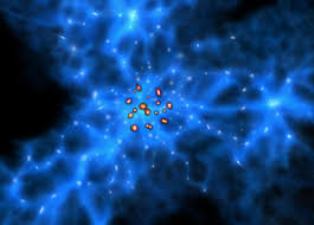
HARROW: Astronomers discovered a nest of monstrous baby galaxies 11.5 billion light-years away using the Atacama Large Millimeter/submillimeter Array (ALMA). The young galaxies seem to reside at the junction of gigantic filaments in a web of dark matter. These findings are important for understanding how monstrous galaxies like these are formed and how they evolve in to huge elliptical galaxies.

We are living in a relatively quiet period in the history of the Universe. Ten billion years ago, long before the Sun and Earth were formed, areas of the Universe were inhabited by monstrous galaxies with star formation rates hundreds or thousands of times what we observe today in the Milky Way galaxy. There aren’t any monstrous galaxies left in the modern Universe, but astronomers believe that these young galaxies matured into giant elliptical galaxies which are seen in the modern Universe.


You might also like

Tesla driverless system to use updated radar technology

12/09/2016

Apple to develop its own self-driving technology

10/09/2016

Current galaxy formation theories predict that these monstrous galaxies form in special environments where dark matter is concentrated. But up until now it has been difficult to determine the positions of active star forming galaxies with enough precision to actually test this prediction. Part of the problem is that monstrous star-forming galaxies are often obscured in dust, making them difficult to observe in visible light. Dusty galaxies do emit strong radio waves with submillimeter wavelengths, but radio telescopes typically have not had the resolution needed to pin-point individual galaxies.


Related Stories

Tesla driverless system to use updated radar technology

byCT Report
12/09/2016

WASHINGTON: Electric carmaker Tesla announced Sunday it was upgrading its Autopilot software to use more advanced radar technology. In a...

Apple to develop its own self-driving technology

byCT Report
10/09/2016

SAN FRANCISCO: Apple may not become an automaker, but it still wants to develop its own self-driving technology. The iPhone-maker's...

NASA spots slowest known magnetar

byCT Report
10/09/2016

WASHINGTON: Astronomers have found evidence of a magnetar - magnetised neutron star - that spins much slower than the slowest...

‘YouTubers’ outshining old-school television

byCT Report
09/08/2016

SAN FRANCISCO: A media revolution is taking place, and most people over 35 years of age aren’t tuned in. Millennial...

Next Post

Xiaomi will send Android 6.0 Marshmallow update to Mi 4 & Mi Note very soon

  • Terms and Conditions
  • Disclaimer

© 2011 Customs Today -World's first newspaper on customs. Customs Today.

No Result
View All Result
  • Transfers and Postings
  • Latest News
  • Karachi
  • Islamabad
  • Lahore
  • National
  • Chambers & Associations
  • Business
  • About Us

© 2011 Customs Today -World's first newspaper on customs. Customs Today.