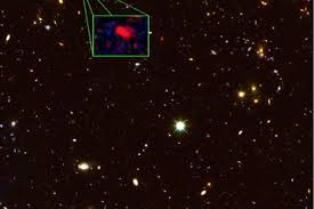


LONDON: An international team of astronomers has discovered an unexpected population of compact interstellar clouds hidden within the nearby dwarf irregular galaxy.
These clouds, which are nestled within a heavy blanket of interstellar material, help explain how dense star clusters are able to form in the tenuous environments of a galaxy thousands of times smaller and far more diffuse than our own Milky Way.
The galaxy is named Wolf-Lundmark-Melotte, more commonly known as WLM, which is located approximately three million light years away from Earth.
“For many reasons, dwarf irregular galaxies like WLM are poorly equipped to form star clusters,” said Monica Rubio, astronomer with the University of Chile and lead author.
These galaxies are fluffy with very low densities. They also lack the heavy elements that contribute to star formation.
“Such galaxies should only form dispersed stars rather than concentrated clusters, but that is clearly not the case,” Ms Rubio noted.
By studying this galaxy with the Atacama Large Millimeter/submillimeter Array (ALMA) telescope in northren Chile, the astronomers were able to locate for the first time compact regions that appear able to emulate the nurturing environments found in larger galaxies.
These regions were discovered by pinpointing the almost imperceptible and highly localised millimeter wavelength light emitted by carbon monoxide (CO) molecules, which are typically associated with star-forming interstellar clouds.
Molecules, and carbon monoxide in particular, play an important role in star formation
Further studies with ALMA will also help determine the conditions that formed the globular clusters found in the halo of the Milky Way.

Karachi Port sets 138-year cargo handling record
KARACHI: Pakistan's maritime sector has achieved a major milestone as Karachi Port set a new record in its 138-year history...