

CANADA: Astronomers said that they had discovered a lost generation of monster stars that ushered light into the universe after the Big Bang and that jump-started the creation of the elements needed for planets and life before disappearing forever.
Modern-day stars like our sun have a healthy mix of heavy elements, known as metals, but in the aftermath of the Big Bang only hydrogen, helium and small traces of lithium were available to make the first stars.
Such stars could have been hundreds or thousands of times as massive as the sun, according to calculations, and burning brightly and dying quickly, only 200 million years after the universe began. Their explosions would have spewed into space the elements that started the chain of thermonuclear reactions by which subsequent generations of stars have gradually enriched the cosmos with elements like oxygen, carbon and iron.
Spotting the older stars in action is one of the prime missions of the James Webb Space Telescope, to be launched by NASA in 2018. The discovery of such stars “would be wonderful,” James Peebles, a Princeton professor and one of the fathers of modern cosmology, said recently.
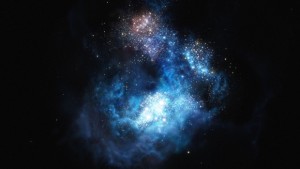
Now, in a paper published in The Astrophysical Journal, an international crew of astronomers led by David Sobral of the University of Lisbon, in Portugal, and the Leiden Observatory, in the Netherlands, said they had spotted the signature of these first-generation stars in a recently discovered galaxy that existed when the universe was only about 800 million years old. Its light has been traveling to us for 12.9 billion years, while succeeding generations of stars have worked their magic to make the universe interesting.
The galaxy, known as CR7, is three times as luminous as any previously found from that time, the authors said. Within it is a bright blue cloud that seems to contain only hydrogen and helium.

Karachi Port sets 138-year cargo handling record
KARACHI: Pakistan's maritime sector has achieved a major milestone as Karachi Port set a new record in its 138-year history...