

Customs Today
  • Home
  • Islamabad
  • Karachi
  • Lahore
  • National
  • Transfers and Postings
  • Chambers & Associations
  • Business
No Result
View All Result
Customs Today
  • Home
  • Islamabad
  • Karachi
  • Lahore
  • National
  • Transfers and Postings
  • Chambers & Associations
  • Business
No Result
View All Result
Customs Today
No Result
View All Result
Home Science & Technology Science

Astronomers discovered the first aurora ever seen beyond our Solar System

byCustoms Today Report
03/08/2015
in Science, Science & Technology
Share on FacebookShare on Twitter

You might also like

Tesla driverless system to use updated radar technology

12/09/2016

Apple to develop its own self-driving technology

10/09/2016

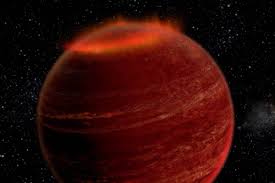
HONG KONG: The beautiful ‘northern lights’-like aurora is not limited to the solar system – in fact it is not even limited to planets as astronomers have discovered the first aurora ever seen in an object beyond our Solar System and that too on a failed star aka brown dwarf.
The LSR J1835+3259 is a brown dwarf some 20 light away and when observed using both radio and optical telescopes, a team led by Gregg Hallinan, assistant professor of astronomy at Caltech, found that the failed stars are more-like supersized planets with planetary features such as powerful auroras near their magnetic poles.
According to researchers, the newly discovered aurora is 10,000 times more powerful than any previously seen. The discovery reveals a major difference between the magnetic activity of more-massive stars and that of brown dwarfs and planets, the scientists say.
“All the magnetic activity we see on this object can be explained by powerful auroras,” said Gregg Hallinan, of the California Institute of Technology (Caltech). “This indicates that auroral activity replaces solar-like coronal activity on brown dwarfs and smaller objects,” he added.
Astronomers observed LSR J1835+3259, using the Karl G. Jansky Very Large Array (VLA) at radio wavelengths, along with the 5-meter Hale Telescope on Palomar Mountain and the 10-meter Keck Telescope in Hawaii at optical wavelengths. The combination of radio and optical observations showed that the object, 18 light-years from Earth, has characteristics unlike any seen in more-massive stars.

Related Stories

Tesla driverless system to use updated radar technology

byCT Report
12/09/2016

WASHINGTON: Electric carmaker Tesla announced Sunday it was upgrading its Autopilot software to use more advanced radar technology. In a...

Apple to develop its own self-driving technology

byCT Report
10/09/2016

SAN FRANCISCO: Apple may not become an automaker, but it still wants to develop its own self-driving technology. The iPhone-maker's...

NASA spots slowest known magnetar

byCT Report
10/09/2016

WASHINGTON: Astronomers have found evidence of a magnetar - magnetised neutron star - that spins much slower than the slowest...

‘YouTubers’ outshining old-school television

byCT Report
09/08/2016

SAN FRANCISCO: A media revolution is taking place, and most people over 35 years of age aren’t tuned in. Millennial...

Next Post

Binary two black holes close orbit around each other

  • Terms and Conditions
  • Disclaimer

© 2011 Customs Today -World's first newspaper on customs. Customs Today.

No Result
View All Result
  • Transfers and Postings
  • Latest News
  • Karachi
  • Islamabad
  • Lahore
  • National
  • Chambers & Associations
  • Business
  • About Us

© 2011 Customs Today -World's first newspaper on customs. Customs Today.