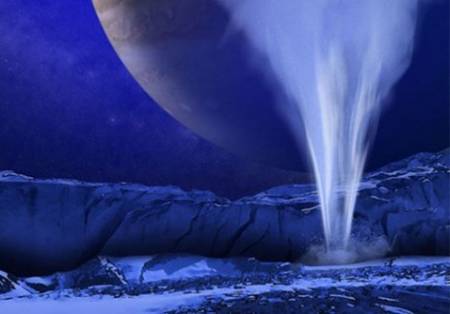


WASHINGTON: The elusive bright spots found on dwarf planet Ceres might actually be volcanoes of ice – spouting hot water vapors off into space, meaning that perhaps this realm too might be a suitable place for life to exist. Images of the Dawn probe suggest that beneath its surface may be a life-giving ocean.
It is also likely that the plumes seen in the picture could be the result of patches of ice catching sunlight, an effect similar to that produced by comets.
The theories were proposed this week at the latest Lunar and Planetary Science conference held outside of Houston. They hope to learn more by mid-April, at which point the Dawn spacecraft will emerge from the dark side of Ceres, within the asteroid belt.
n January of 2014, the Herschel space observatory made the first official detection of water vapor on Ceres. In 2004, the Hubble telescope released images from the Hubble space telescope indicating the presence of water ice.
Two light spots were seen inside one of the craters in black-and-white images that were beamed to Earth back in mid-February when Dawn homed in on Ceres. A full, nine-hour rotation of the dwarf planet, revealed its brightest spot, overlooking a crater rim.
NASA’s Dawn spacecraft began its orbit of Ceres early on Friday morning and will soon document all there is about it. Of course, the obvious question is whether it is capable of supporting life.
“We believe this could be some kind of outgassing,” said the camera’s supervisor, Andreas Nathues to New Scientist on Tuesday.
“Could the bright spot be an icy plume caused by the vaporization of Ceres’ surface as it turns towards the sun’s heat, and then dropping away as night falls?” wrote Monica Grady, who is a professor of planetary and space sciences at the Open University and suspects that Ceres is showing signs of cometary activity. “Corridor talk at the conference speculates that Ceres might be closer to a comet than the asteroid it is usually regarded as.”
Since its launch in September of 2007, Dawn has traveled over 3.1 billion miles to its rendezvous with Ceres, which itself is located 310 million miles away from Earth. It entered Ceres’ gravitational pull at the beginning of the month, after it finished an investigation of the asteroid Vesta.

Karachi Port sets 138-year cargo handling record
KARACHI: Pakistan's maritime sector has achieved a major milestone as Karachi Port set a new record in its 138-year history...