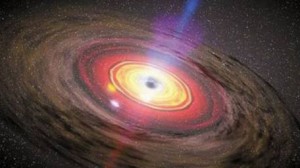


MEXICO: University of Michigan astronomers have found the smallest black hole ever observed in the centre of a galaxy
As supermassive black holes go it’s really not that super or massive,
In a dwarf, disc galaxy 340 million light years away, University of Michigan astronomers have found the smallest black hole ever observed in the centre of a galaxy.
At just 50,000 times the mass of the sun, it’s more than two times smaller than any other known object of its kind. It’s a full 100,000 times less massive than the largest black holes at the heart of other galaxies.
“In a sense, it’s a teeny supermassive black hole,” said Elena Gallo, assistant professor of astronomy in the U-M College of Literature, Science, and the Arts.
However despite its diminutive size it appears to be is consuming material at a rate similar to active black holes in much more massive galaxies
Black holes come in two types. The “stellar mass” variety have the mass of several suns. They form when the largest stars die and collapse. The other “supermassive” kind is typically at least 100,000 times the mass of the sun.
Every large galaxy, including our own Milky Way, is believed to have a supermassive black hole at its core. But the recently discovered object is one of the first to be identified in a dwarf galaxy.
And because the dwarf galaxy, called RGG 118, is so small, it’s unlikely that it has ever merged with other galaxies, so it gives researchers a window to a younger universe. Larger galaxies are thought to have grown through mergers.

Karachi Port sets 138-year cargo handling record
KARACHI: Pakistan's maritime sector has achieved a major milestone as Karachi Port set a new record in its 138-year history...