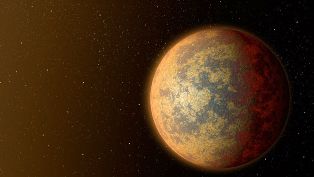


NEW YORK: It comprises four planets – one giant and three super-Earths orbiting a star dubbed HD219134.
Apart from these super-Earths, the newly found planetary system documented around HD219134 holds a giant planet that scientists say resembles Saturn and that takes 3 years to orbit its parent star.
Astronomers from University of Geneva, who had been part of the research, said, “Its mean density is close to the density of Earth, suggesting a possibly similar composition as well”.
“When the primary HARPS-I radial-velocity measurements indicated the presence of a 3-day planet round HD219134, we instantly requested NASA for Spitzer area telescope time”, stated Ati Motalebi, astronomer at University of Geneva (UNIGE) and first writer of the paper describing the invention. If the planetary system has the right alignment it can also transit-pass between us and the star and block some of the starlight-which will reveals the size of the planet.
Michael Werner, the project scientist for the Spitzer mission said that transiting exoplanets were worth their weight in gold because they can be extensively characterised.
The lately found solution has at its core a pygmy stars professionally titled Human resource 8832 that’s brilliant a sufficient amount to be seen having the bare off but lighting control and less space-consuming than our sunshine.

Karachi Port sets 138-year cargo handling record
KARACHI: Pakistan's maritime sector has achieved a major milestone as Karachi Port set a new record in its 138-year history...