
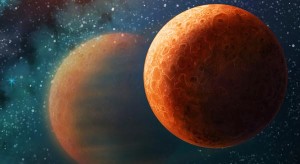
LONDON: Determining the size of an Earth-size exoplanet by the amount of starlight it blocks hundreds of light-years away once was the realm of science fiction. Measuring the mass of such a small planet based on its gravity was another level entirely, but astronomers have done just that for an exoplanet fifty percent the size of Earth.
Researchers using NASA’s Kepler mission data have measured the mass of a Mars-size exoplanet that is about one tenth the mass of Earth. Called Kepler-138b, it is the first exoplanet smaller than Earth to have both its mass and size measured. This significantly extends the range of planets with measured densities.


To determine a planet’s mass, astronomers typically measure the minuscule movement of the star caused by the gravitational tug of an orbiting planet. For planets the mass of Earth detecting such a tiny tug is extraordinarily challenging with current technology. Fortunately, when a star hosts multiple planets that orbit closely together, scientists have developed another way to get at the planets’ masses.
Daniel Jontof-Hutter, a research associate at the Pennsylvania State University’s Center for Exoplanets and Habitable Worlds, led a team of astronomers in a study to measure the mass of all three planets by precisely observing the times each planet passed in front of, or transited, the star Kepler-138.
“Each planet periodically slows down and accelerates ever so slightly from the gravity of its neighboring planets. The slight change in time between transits allows us to measure the masses of the planets,” said Jontof-Hutter.



