You might also like


CANADA: The origin of type Ia supernovae, the standard candles used to reveal the presence of dark energy in the universe, is one of astronomy’s most beguiling mysteries. Astronomers know they occur when a white dwarf explodes in a binary system with another star, but the properties of that second star — and how it triggers the explosion — have remained elusive for decades.
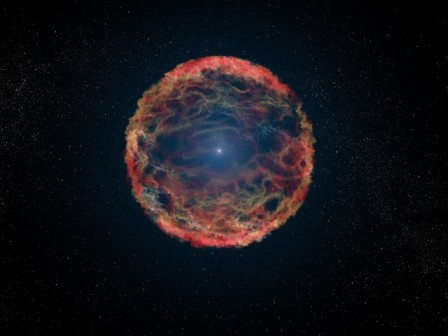
Now, a team of astronomers from the intermediate Palomar Transient Factory (iPTF), including those associated with UC Santa Barbara, have witnessed a supernova smashing into a nearby star, shocking it, and creating an ultraviolet glow that reveals the size of the companion. The discovery involved the rapid response and coordination of iPTF, NASA’s Swift satellite and the new capabilities of the Las Cumbres Observatory Global Telescope Network (LCOGT).
The supernova, named iPTF14atg, is located 300 million light-years away in the galaxy IC 831. The study, appearing in the May 21st issue of Nature, was led by graduate student Yi Cao of Caltech, but included physics postdoctoral fellows Iair Arcavi and Stefano Valenti, and physics faculty member Andrew Howell of UCSB and LCOGT.