
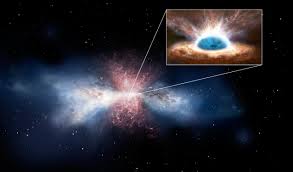


WASHINGTON: The Integral, Fermi and Swift space observatories have used the magnifying power of a cosmic lens to explore the inner regions of a supermassive black hole.
Gamma rays are highly energetic radiation emitted by some of the most extreme objects in our Universe. Jets of gamma rays moving at close to the speed of light stream from the areas around black holes, for example. These jets are thought to be emitted by superheated material spinning wildly as it is devoured by the hungry black hole.
Our telescopes will never be powerful enough to reveal these inner regions, and scientists struggle to examine exactly how these jets are unleashed into the Universe.
“Because we can’t clearly see what’s going on, we don’t fully understand this behaviour,” says Andrii Neronov of the University of Geneva, Switzerland, lead author on the Nature Physics paper published online today.
“However, our method allowed us to ‘resolve’ this region, and get an insight into the patch of space directly surrounding a supermassive black hole known as PKS 1830-211.”
This black hole lies many billions of light-years away. Neither ESA’s Integral satellite nor NASA’s Fermi gamma-ray telescope can observe the region unaided, but a lucky coincidence provides a helping hand: gravitational microlensing.

Karachi Port sets 138-year cargo handling record
KARACHI: Pakistan's maritime sector has achieved a major milestone as Karachi Port set a new record in its 138-year history...


