Customs Today
  • Home
  • Islamabad
  • Karachi
  • Lahore
  • National
  • Transfers and Postings
  • Chambers & Associations
  • Business
No Result
View All Result
Customs Today
  • Home
  • Islamabad
  • Karachi
  • Lahore
  • National
  • Transfers and Postings
  • Chambers & Associations
  • Business
No Result
View All Result
Customs Today
No Result
View All Result
Home Science & Technology Science

Astronomers use VISTA telescope to discover hundreds of previous massive galaxies

bySana Anwar
24/11/2015
in Science, Science & Technology
Share on FacebookShare on Twitter

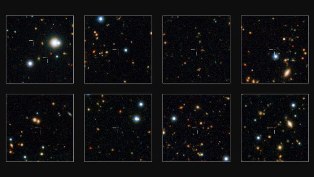
BRENT: Astronomers have used the European Southern Observatory’s VISTA telescope to discover hundreds of previously undetected massive galaxies. The findings are localized to a small patch of sky, and their discovery provides clues as to when such objects first emerged in the early Universe.

While any given patch of sky plays host to countless galaxies, they become much more difficult to detect the more distant they are, appearing fainter and often obscured by foreground objects. Massive galaxies – which are a minimum of 50 billion times the mass of the Sun – are some of the brightest such objects (and therefore some of the easiest to spot when they’re close to home), they become far less common the deeper you peer into the early Universe.


You might also like

Tesla driverless system to use updated radar technology

12/09/2016

Apple to develop its own self-driving technology

10/09/2016

The new research picks out hundreds of previously unidentified distant galaxies by analyzing VISTA telescope near-infrared wavelength imagery. Making observations in this wavelength allows astronomers to see through obscuring clouds of dust that hide distant objects from view in visible light observations.

All 574 galaxies are located in a single patch of sky that appears around four times the size of a full Moon – a region VISTA has been focused on for some six years. Those images were combined with data recorded by NASA’s Spitzer Space Telescope, which works with mid-infrared wavelengths.

The discoveries represent the largest ever sample of massive galaxies in the early Universe. Studying them is helping scientists pinpoint when the first ever massive galaxies appeared.

The findings reveal a huge growth in the number of these objects in a short period of time, with a large number of the massive galaxies having already formed as little as three billion years after the Big Bang, a full 11 billion years ago. Furthermore, no evidence was found of such galaxies existing earlier than one billion years after the Big Bang.


Related Stories

Tesla driverless system to use updated radar technology

byCT Report
12/09/2016

WASHINGTON: Electric carmaker Tesla announced Sunday it was upgrading its Autopilot software to use more advanced radar technology. In a...

Apple to develop its own self-driving technology

byCT Report
10/09/2016

SAN FRANCISCO: Apple may not become an automaker, but it still wants to develop its own self-driving technology. The iPhone-maker's...

NASA spots slowest known magnetar

byCT Report
10/09/2016

WASHINGTON: Astronomers have found evidence of a magnetar - magnetised neutron star - that spins much slower than the slowest...

‘YouTubers’ outshining old-school television

byCT Report
09/08/2016

SAN FRANCISCO: A media revolution is taking place, and most people over 35 years of age aren’t tuned in. Millennial...

Next Post

South Korean stocks shoot up by 0.44% at lunch time

  • Terms and Conditions
  • Disclaimer

© 2011 Customs Today -World's first newspaper on customs. Customs Today.

No Result
View All Result
  • Transfers and Postings
  • Latest News
  • Karachi
  • Islamabad
  • Lahore
  • National
  • Chambers & Associations
  • Business
  • About Us

© 2011 Customs Today -World's first newspaper on customs. Customs Today.