
Customs Today
  • Home
  • Islamabad
  • Karachi
  • Lahore
  • National
  • Transfers and Postings
  • Chambers & Associations
  • Business
No Result
View All Result
Customs Today
  • Home
  • Islamabad
  • Karachi
  • Lahore
  • National
  • Transfers and Postings
  • Chambers & Associations
  • Business
No Result
View All Result
Customs Today
No Result
View All Result
Home Science & Technology Science

Astronomers watch ruthless black hole tear apart a star

byCustoms Today Report
26/10/2015
in Science, Science & Technology
Share on FacebookShare on Twitter

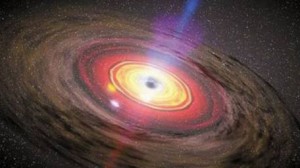
LONDON: Ever thought about going near a black hole? Well, NASA has confirmed that you probably shouldn’t. A new animation released by the agency shows what happens when a star gets torn apart by the gravitational pull of a black hole.

In the animation, the star passes a little too close to the black hole, at which point its gravitational pull takes hold. Massive tidal forces then rip the star to pieces with some of the debris being catapulted into space and some of it falling around the black hole and forming a massive gaseous disk.


You might also like

Tesla driverless system to use updated radar technology

12/09/2016

Apple to develop its own self-driving technology

10/09/2016

While the animation is an artist’s rendering, it is supposed to illustrate a particular interaction between the star and black hole, which has been observed by three X-ray telescopes. The interaction is known as ASASSN-14li, and is located about 290 million light years away at the center of a galaxy.

Researchers were able to observe this interaction by looking at X-rays surrounding it. When a star is destroyed by a black hole, the debris around it is heated up by a few million degrees, at which point it brightly glows with X-ray light.

Of course, stars aren’t the only potential victims of black holes. Black holes are extremely dense meaning that nothing at all, including light, is able to escape their pulls. Experts suggest that if a person went too near to a black hole they would be stretched into a very long tube-like figure before being blasted into many subatomic particles.


Related Stories

Tesla driverless system to use updated radar technology

byCT Report
12/09/2016

WASHINGTON: Electric carmaker Tesla announced Sunday it was upgrading its Autopilot software to use more advanced radar technology. In a...

Apple to develop its own self-driving technology

byCT Report
10/09/2016

SAN FRANCISCO: Apple may not become an automaker, but it still wants to develop its own self-driving technology. The iPhone-maker's...

NASA spots slowest known magnetar

byCT Report
10/09/2016

WASHINGTON: Astronomers have found evidence of a magnetar - magnetised neutron star - that spins much slower than the slowest...

‘YouTubers’ outshining old-school television

byCT Report
09/08/2016

SAN FRANCISCO: A media revolution is taking place, and most people over 35 years of age aren’t tuned in. Millennial...

Next Post

China stocks hike by midday, Shanghai Composite ascends 0.72%

  • Terms and Conditions
  • Disclaimer

© 2011 Customs Today -World's first newspaper on customs. Customs Today.

No Result
View All Result
  • Transfers and Postings
  • Latest News
  • Karachi
  • Islamabad
  • Lahore
  • National
  • Chambers & Associations
  • Business
  • About Us

© 2011 Customs Today -World's first newspaper on customs. Customs Today.