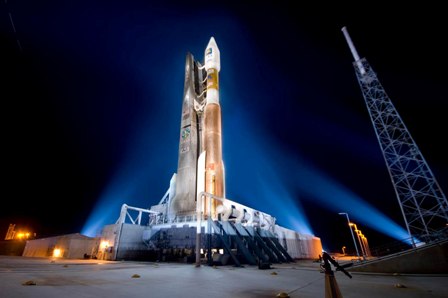
LONDON: A strong Atlas 5 rocket blasted its way into space, shipping a 15,000 pound Navy communications satellite. This satellite is the third of five relay stations designed for a new $5 billion global network, planned to grip high-speed mobile phone traffic as well as voice and data from other, elder systems.
The 206-foot-tall rocket shot into space at 8:04 p.m. EST lighting up the night sky. Liftoff occurred 21 minutes late due to high winds and radio interference with an Air Force Eastern Range system, needed to send self-destruct commands in the event of a major launch failure.


The five strap-on boosters fell away just under two minutes after liftoff and the Atlas’ first stage followed suit two-and-a-half minutes later. The Centaur second stage continued the push to orbit using a Rocketdyne RL10C-1 engine, generating almost 23,000 pounds of thrust. A second Centaur firing went well with a third planned hours after launch to put the satellite into an elliptical “transfer” orbit.
The satellite’s on-board propulsion system will be used over the next week to raise the orbit and place the satellite in orbit 22,300 miles above the equator.
Lock head Martin’s website described the new relay stations as “a next-generation narrowband tactical satellite communications system designed to significantly improve ground communications to U.S. forces on the move around the globe.”
“MUOS will provide military users more communications capability over existing systems, including simultaneous voice, video and data — similar to the capabilities experienced today with smart phones,” company spokespersons say.
Navy Capt. Paul Ghyzel, manager of the Satellite Communications Program Office, said before the MUOS-2 launch last summer the new satellites operate like cell phone towers in space.
“Anybody (who) is using a radio that is capable of communicating with MUOS, when they speak, their transmission is picked up by the satellite and then routed like a cellular system would route to wherever it needs to be to talk to the guy on the other end,” Ghyzel says.
The satellites will be replacing the Navy’s older UHF comsats and will be able to route calls directly between users or relay calls to other MUOS satellites, to connect more widely separated users much like cell phone towers on Earth.
“With MUOS, we’ve taken commercially available cell phone technology that I think we’re all kind of familiar with in our daily lives, except that our cell towers are 22,000 miles above us on that satellite,” Cmdr. Pete Sheehy says. “By doing that, we’ve enabled a ten times increase in the number of users that we can accommodate, as well as things like adaptive power control that allows disadvantaged users or very mobile users the ability to very reliably maintain connections.
“In addition to that, if you think about the days when you had your old flip phone and all you used it for was voice and maybe a couple of texts, we’ve now allowed our users to connect to Navy and government classified networks, as well as unclassified networks and government phone systems, so it operates similar to smart phones in use today.”