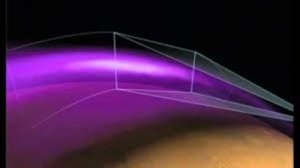


NEW YORK: NASA recently announced a surprising sight from its Martian observatory: An intense aurora had blanketed the planet’s northern hemisphere in a rippling veil of light. Such light shows aren’t uncommon on Earth—a solar storm last week made for spectacular views of the night sky over Alaska and elsewhere—but scientists have rarely seen what we’d call Northern Lights on Mars.
But when they do see them, the lights over Mars look different.
“If you look at the colors, there will be red and green, kind of like Christmas lights,” said Nicholas Schneider, the lead for the MAVEN spacecraft’s imaging ultraviolet spectrograph instrument. MAVEN scans Mars’s horizon for strange occurrences within its atmosphere.
Auroras appear when a wave of charged particles fired off from the sun hits a planet’s magnetic field. On Earth, the magnetic field funnels the plasma deluge into its poles. Mars’s atmosphere contains traces of oxygen and other particulates, which glow green and red when struck with stellar electrons, according to Schneider. Absent from Mars’s auroral palette is the color blue, a prominent hue in aurora borealis seen from Earth. That’s because blue comes from nitrogen, an element that is abundant in Earth’s atmosphere but scarce within Mars’s sky. Mars lost its complete magnetosphere billions of years ago, so when it gets blasted by the sun’s charged particles, its atmosphere paints a different picture than what we see in the Earth’s sky.
The other difference between our auroras and those that appear on the Red Planet is texture. Earth’s auroras are like a swirling river of light—an intricate pattern that results from the complexities within our planet’s magnetic fields. But Schneider says that on Mars the aurora appears as a singular, pulsating glow across the sky. That’s because it lacks a sophisticated magnetic sphere to alter incoming electrons. Auroras on Mars also stretch across the hemisphere because there is no magnetic field to direct it. Which means a Martian aurora could fill the sky, rather than collecting just around the planet’s poles like on Earth.

Karachi Port sets 138-year cargo handling record
KARACHI: Pakistan's maritime sector has achieved a major milestone as Karachi Port set a new record in its 138-year history...