

Customs Today
  • Home
  • Islamabad
  • Karachi
  • Lahore
  • National
  • Transfers and Postings
  • Chambers & Associations
  • Business
No Result
View All Result
Customs Today
  • Home
  • Islamabad
  • Karachi
  • Lahore
  • National
  • Transfers and Postings
  • Chambers & Associations
  • Business
No Result
View All Result
Customs Today
No Result
View All Result
Home Science & Technology Science

Auroras touch brown dwarfs for the first time

byCustoms Today Report
31/07/2015
in Science, Science & Technology
Share on FacebookShare on Twitter

You might also like

Tesla driverless system to use updated radar technology

12/09/2016

Apple to develop its own self-driving technology

10/09/2016

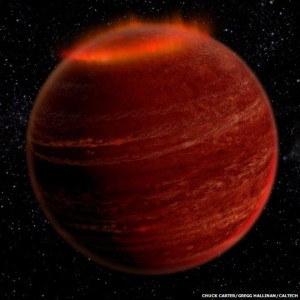
MEXICO: In a rather spectacular finding, researchers from the California Institute of Technology have observed auroras on brown dwarfs for the first time. The findings of their study were published in the journal Nature. This has helped them conclude that brown dwarfs might be a lot more planet-like than previously thought.
The team of researchers used optical and radio telescopes over a five-year period, to look for radio pulsations and optical signature of aurora beyond our solar system. They detected radio and optical emissions from a rapidly rotating brown dwarf located about 18.5 light years away, named LSR J1835+13259. Ever since, optical and radio auroras have been observed on even smaller and cooler brown dwarfs.
Brown dwarfs do not have enough mass to reach the necessary core temperatures and pressures for nuclear fusion, the process that makes stars like our Sun shine. Instead, brown dwarfs fill the gap between the smallest stars called red dwarfs, and the largest planets, the gas giants like Jupiter.
All planets with magnetic fields produce auroras when charged particles in the solar wind interact with the planet’s magnetosphere. However, for brown dwarfs, since there is no star, so there is no stellar wind, so most likely there is an Earth-sized planet sitting very close powering the aurora.
The international research team is planning further observations over the next year using optical telescopes including Hubble and Keck, to delve deeper into the possible reasons that cause these stunning visual displays.

Related Stories

Tesla driverless system to use updated radar technology

byCT Report
12/09/2016

WASHINGTON: Electric carmaker Tesla announced Sunday it was upgrading its Autopilot software to use more advanced radar technology. In a...

Apple to develop its own self-driving technology

byCT Report
10/09/2016

SAN FRANCISCO: Apple may not become an automaker, but it still wants to develop its own self-driving technology. The iPhone-maker's...

NASA spots slowest known magnetar

byCT Report
10/09/2016

WASHINGTON: Astronomers have found evidence of a magnetar - magnetised neutron star - that spins much slower than the slowest...

‘YouTubers’ outshining old-school television

byCT Report
09/08/2016

SAN FRANCISCO: A media revolution is taking place, and most people over 35 years of age aren’t tuned in. Millennial...

Next Post

Microsoft recorded 14m devices running Windows 10

  • Terms and Conditions
  • Disclaimer

© 2011 Customs Today -World's first newspaper on customs. Customs Today.

No Result
View All Result
  • Transfers and Postings
  • Latest News
  • Karachi
  • Islamabad
  • Lahore
  • National
  • Chambers & Associations
  • Business
  • About Us

© 2011 Customs Today -World's first newspaper on customs. Customs Today.