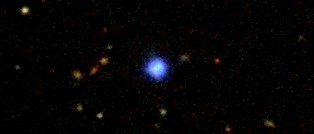


PERTH: Australian astronomers have discovered disks of gas and dust around two relatively close red dwarf stars that could reveal clues about the formation of planets.
A team from the Australian National University and the University of New South Wales detected the disks – which are about 380 million light years from Earth – by chance using a powerful telescope while examining the Scorpio-Centaurus region of the sky.
These types of disks form around young stars but then disappear as the material in them accretes to form groups of orbiting planets like our solar system.
To date, scientists had thought that these disks disappeared after approximately five million years, giving way to planets that take another several million years to fully solidify.
The discovery by the Australian scientists, however, could show that there are planets that take longer to form, a situation that would open up new areas of research.
“All planets are born within the ‘circumstellar’ disk of gas and dust, and these disks usually last for less than five million years,” according to astronomers’ calculations, the head of the research team, ANU astronomer Simon Murphy, told EFE.
The rocky planets created from the accumulation of smaller bits of dust, stone and other material form in about 10 million years, and the disks dissipate within that time, although gas giants like Jupiter and Saturn take several million years more to agglomerate.
However, according to Murphy, finding disks around red dwarf stars thought to be 15 million years old “is convincing evidence that the disks around stars with masses less than that of the Sun could last longer than had been thought”.

Karachi Port sets 138-year cargo handling record
KARACHI: Pakistan's maritime sector has achieved a major milestone as Karachi Port set a new record in its 138-year history...