
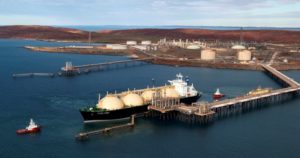
CANBERRA: Australia’s natural gas export boom, which is causing soaring gas prices and pushing up carbon emissions, appears to be rapidly shedding value. Santos wiped more than $1bn off the value of its liquefied natural gas plant in Queensland on Tuesday, just a week after Origin announced a similar devaluation. The devaluations were predicted by commentators, who pointed out previous devaluations of the projects relied on overly-optimistic forecasts.
“The whole project was built on over-inflated forecasts,” said Dan Gocher from the financial activist group Market Forces. The Santos share price dipped a further 2.39% on Tuesday morning after a drop of more than 85% since its peak in 2008. “This industry has torn up its shareholders’ wealth and now it’s tearing up the nation’s wealth,” said Bruce Robertson from the pro-renewables Institute for Energy Economics and Financial Analysis. On Tuesday Santos announced it was expecting to wipe more than A$1bn off the value of its GLNG plant on Curtis Island in Queensland. Just last week Origin announced a post-tax $815m devaluation of its APLNG facility on Curtis Island – a figure that implies more than a billion-dollar devaluation before tax. Along with another facility on Curtis Island owned by Shell, the three plants are responsible for Australia’s LNG export boom, which has been vacuuming Australia’s gas and caused domestic prices to skyrocket. Each plant has been shedding value since construction began. Shell’s plant was US$7bn over budget, and then suffered a $5.4bn pre-tax devaluation in 2015. Between Santos and Origin, the two plants have now been devalued by about $6bn. Meanwhile, Australia’s greenhouse gas emissions rose dramatically in the latest quarterly emissions report, a rise that is mostly caused by the operation of the three LNG plants. Those emissions have widely been acknowledged as massively underestimated, since fugitive emissions – leaks of unburned gas – are poorly monitored. Gocher said the poor finances of the operations shows a huge opportunity was wasted. “I think $60bn was put into it, and that wasn’t a long time ago, and that could have gone to transitioning our electricity industry,” Gocher said. “That capital was sourced from shareholders, and it could have been directed elsewhere. And now each year more of it is getting written off.”


Export gas prices are linked to the price of oil, and Santos said lower-than-expected oil prices were to blame for the devaluation. But Santos came under criticism in 2016 when it announced an even bigger devaluation, with commentators pointing out it relied on a heroic oil price forecast, inflating the remaining value of the facility. At the time, its forecasted oil prices were higher than that of the World Bank and Goldman Sachs, as well as competitors Woodside Petroleum and Beach Energy. The company has now downgraded its forecast, causing the new loss of value. But even the new forecasts appear more optimistic of a bounce in the oil price than even Origin.



