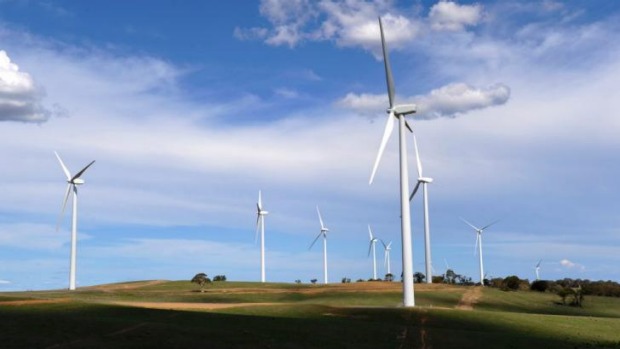
CANBERRA: The Australian Senate’s decision on 24 June to reduce Australia’s Large-Scale Renewable Energy Target from 41TWh in 2020, to 33TWh, could clear the murky waters of policy uncertainty troubling the sector since early 2014. According to Bloomberg New Energy Finance, the decision should pave the way for more than AUD 14bn ($11bn) in new wind and solar project investment.
However, the research firm’s Market Outlook in response to the policy change says: “New off-take contracts do not appear to be forthcoming [and] there is a high degree of uncertainty on revenue post-2020, which we think could threaten the viability of the target.”


The research says that the degree of merchant risk exposure will depend upon whether the market functions with long-term (15 year) off-take contracts, or without. If the latter were to be the case, risk profiles would increase, making project finance costs higher, largely due to revenue uncertainty.
Despite these words of warning, Australia is already seeing movement in the sector. Shortly following parliament’s approval of the policy review, General Electric announced agreement deal to help finance and supply turbines to the nation’s third-largest wind farm, the 240MW Ararat site in Victoria at a value of AUD 450m ($348m), with partners including Renewable Energy Systems and Partners Group. Meanwhile, Senvion also made the headlines for its plan to develop an AUD 1.5bn ($1.2bn) wind farm in South Australia, with a capacity of 600MW.
Strong growth in investment in clean power all the way to 2040 is what Bloomberg New Energy Finance predicts in its New Energy Outlook 2015. The report, published last week, says: “Renewables will command just under 60% of the 9,786GW of new generating capacity installed over the next 25 years, and two-thirds of the $12.2 trillion of investment.” It expects developing countries to “build nearly three times as much new capacity as developed nations,” due to catch-up economic growth and rising electrification in the former, while improved energy efficiency will reduce energy consumption in the latter.
A substantial amount of funding is expected to come in the form of debt, as banks become increasingly accustomed to renewable energy project financing. Last week the Inter-American Development Bank approved a $65m loan to support renewable energy in Nicaragua, which will also support measures to reduce energy loss and improve energy efficiency.
South of the Equator, Votorantim Industrial made its first move in wind energy last week, when it agreed to buy a 600MW wind energy project from Brazilian developer Casa dos Ventos. Votorantim plans to invest about BRL 3bn ($970m) in the project, located in the northeastern state of Piaui, and is already in talks with General Electric to supply the wind turbines.
In the US, Sunrun, a San Francisco-based developer of rooftop solar systems, announced it is planning to raise as much as $100m through an initial public offering on the Nasdaq exchange.
Meanwhile, Republican Senator Charles Schumer praised Obama for his action on climate change, and said his party might be amenable in 2017 to carbon fee legislation, due to the additional source of revenue it would provide for the government, as long as it does not directly impose a tax on the American people.
Over the border in Canada, Alberta made a first step in revamping its climate regulations in a bid to reduce the environmental impact of its oil-sands industry. The province will increase its carbon price for industrial emitters, from the current CAN 15 (US$12 or AUD$31) a tonne, to twice that in 2017, when the rules will expire. A total of 6m tonnes of CO2 emissions will be eliminated over the next two years because of the new regulations.
Across the Atlantic, London-based quoted fund The Renewables Infrastructure Group, or TRIG, increased its portfolio by around 50%, with its GBP 246m ($388m) purchase of six onshore wind farms in Scotland, totalling 433MW of capacity.
In the Middle East, that region’s biggest solar power plant is reaching fruition – a project the size of 100 soccer fields. First Solar has been contracted to supply 2.4m solar panels for the second stage of the 200MW project in Dubai, scheduled to start operating in early 2017.