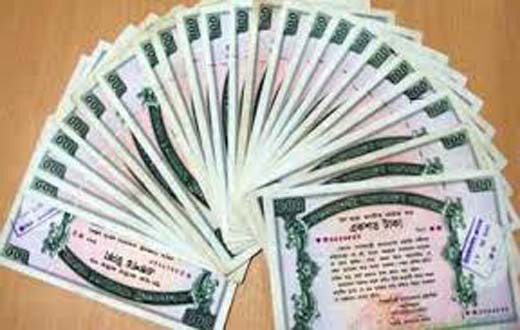
DHAKA: Bangladesh’s three state banks are going to issue different types of bonds worth Tk410 million to meet a huge shortfall of capital.
The central bank has already given primary consent to BASIC Bank, Janata Bank and Rupali Bank with some conditions, to help them improve their financial health.


BASIC Bank will issue cashless bonds of Tk260 million which will only be used to show the bank’s financial health as strong, said a finance ministry official.
Against the bond, BASIC Bank Interest Free Capital Bond, the bank cannot raise money from the market.
The government’s liability is that if the bank ever folds up, it will have to repay the money on behalf of BASIC Bank. The finance ministry has consented to the issue of a 10-year Tk800 crore bond, 15-year Tk800 crore bond and 20-year Tk1,000 crore bond.
Although the type of bond BASIC Bank wants to issue is new in Bangladesh, it has been issued in Asia before.
During the Asian economic crisis in 1997, Thailand, Malaysia and China issued such bonds to enable their financial institutions to function properly, the finance ministry official added.
In 2009, when Abdul Hye Bachchu was made chairman of BASIC Bank, the bank’s financial situation started to deteriorate due to various scams.
Despite initiatives to improve its financial health after the appointment of Alauddin A Majid as the chairman in July 2014, the bank is still suffering from a huge capital deficit and increasing classified loans.
The government provided BASIC Bank Tk2,600 crore in phases. As on December 31 last year, the bank’s capital shortfall was Tk2,684 crore.
The bank’s non-performing loan (NPL) was Tk7,229 crore, which is 54 percent of its total outstanding loans as of December 31 last year. BASIC’s NPL was Tk6,392 crore a year ago.
On the other hand, Janata and Rupali will issue subordinated bonds worth Tk1,000 crore and Tk500 crore respectively, said an official of Bangladesh Bank.
Subordinated debt is a loan or security that ranks below other loans and securities with regard to claims on a company’s assets or earnings. It is more risky, as it is paid after all other debts are repaid, in case of borrower default.
Against this bond, the two banks can raise money from the market but they have to invest the money in profitable sectors.
Janata Bank’s capital shortfall is Tk73 crore, with a capital to risk-weighted assets ratio (CRAR) of 10.19 percent, which is required to be above 10.6 percent.
Rupali Bank’s capital shortfall is Tk714 crore, with a CRAR of only 5.88 percent.