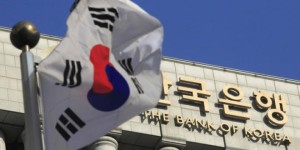
SEOUL: The usually conservative The Bank of Korea (BOK) has investigated into the effects of a negative interest rate policy on local economy even as it officially maintained opposed to the government’s repeated pressure to do more and proactively to aid the economy.
According to BOK documents obtained by Representative Song Young-gil of the Minjoo Party of Korea, the central bank has requested two groups of experts to conduct studies on the effects of adopting a negative interest rate. The first study on the cases of negative interest rate management and soundness of financial institutions has been outsourced to a team led by Professor Han Jae-joon of Inha University in August while the second study on the impact of negative interest rate on overall financial stability has been requested to a team co-led by Professor Huh In of Catholic University and Professor Ahn Ji-yeon of KyungHee University. The BOK is known to have paid 10 million won ($9,140) for each study. The central bank, however, made clear that “the outsourced studies are on overseas cases and theories” and that “they do not reflect BOK’s future monetary policy direction.” It reiterated that the BOK “is not considering adopting a negative interest rate policy.”


Amid ongoing research on behalf of BOK, the political circle is criticizing the central bank for trying to keep pace with the government’s efforts to stimulate the economy ahead of the presidential election next year. There have also been skeptic views on the actual impact keeping interest rates below zero brings to the overall economy as major economies that have already introduced negative interest rate environment to stimulate the economy have not seen much effect.
When interest rates are pushed into the negative territory, the central bank receives fees for current account deposits including payment reserves from commercial banks rather than paying interest. In theory, having a negative interest rate raises expectations for economic stimulation as more money is released on the market instead of being kept at banks. So far, the BOK had maintained the position that it is too early to consider the possibility of adopting a negative interest rate policy, however, recent studies outsourced to experts show the option was laid on the table. In September, the BOK kept its benchmark rate unchanged at an all-time low of 1.25 percent after lowering it by 25 basis points in June amid economic risks at home and abroad.
Industry observers note that the BOK has turned more open to the possibility of introducing a negative interest rate policy as one of the economic stimulus measures to prepare for prolonged economic decline due to sluggish exports in traditional industry sectors such as steel and petrochemical as well as shock from restructuring in shipbuilding and shipping sectors. Song accused the bank of studying negative rate when household debt is snowballing can only be suspected as an aim to help the ruling party ahead of the presidential election next year.