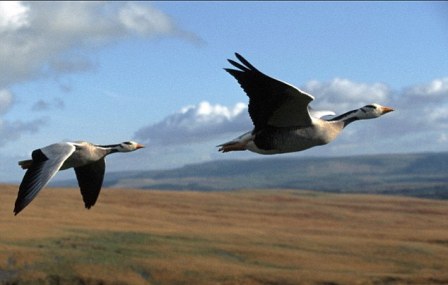
WASHINGTON: Researchers looked at the “roller coaster” migratory flights of geese to gain insight into how the birds fly through thin high-altitude mountain air. Bar-headed geese, which migrate annually south from breeding grounds in Mongolia to southern Tibet or India, have learned how to have a little fun along the way, according to a study published Jan. 15 in the journal Science
Only seven of them got wounded and provided unstable data. However, the data obtained from the rest of them were contradictory to the long accepted notion about the behavior of these migratory birds. University of Bangor lead researcher Charles Bishop said “At the beginning we were just puzzled that there were so few reports of very high flight over the last 60 years.” Bishop added “We knew that these birds were especially well-adapted to fly in air containing very low oxygen, so we certainly expected to record some high flights. The question was how high did they normally fly? For how long? And how difficult were such flights? How close to the limit did they have to go?”


Previously it was thought that bar-headed geese mainly migrate at high altitudes. However, this study unveiled that while flying over the Himalayas, the birds come closer to the mountainous terrain and fly with a roller coaster-like pattern. Biologists believe that the efficient respiratory systems and massive wing strength of bar-headed geese allow them to endure long high-altitude flights.
As per the new study, during their flight the geese search for low altitudes where oxygen is present in abundance. Bishop explained “I think it is the most economical way to travel through the mountains.” He also stated “However, it appears that the winds were seldom blowing in the right direction to help the geese with their migrations, so the best thing to do is stay as low as possible and keep in the most dense air available.”