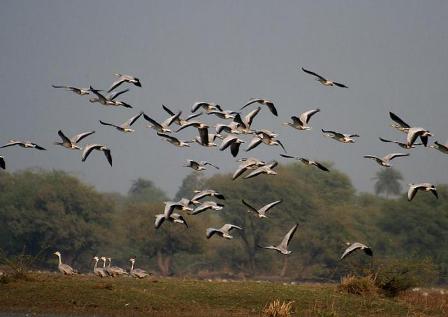
WASHINGTON: Researchers looked at the “roller coaster” migratory flights of geese to gain insight into how the birds fly through thin high-altitude mountain air. Bar-headed geese, which migrate annually south from breeding grounds in Mongolia to southern Tibet or India, have learned how to have a little fun along the way, according to a study published Jan. 15 in the journal Science
Before the geese’s annual flight in 2011, an international team of researches implanted 30 geese with monitors that measure heart rate, body movement, and altitude. While only seven wound up providing usable data, the results were surprising and contradicted long-held assumptions about the birds’ migratory behavior.
You might also like


“At the beginning we were just puzzled that there were so few reports of very high flight over the last 60 years,” said University of Bangor lead researcher Charles Bishop in a report by the Christian Science Monitor. “We knew that these birds were especially well-adapted to fly in air containing very low oxygen, so we certainly expected to record some high flights. The question was how high did they normally fly? For how long? And how difficult were such flights? How close to the limit did they have to go?”
Contradicting the notion that bar-headed geese migrate mainly at high altitudes, Bishop’s study shows that as the birds soar over the Himalayas, they fly close to the mountainous terrain, in a roller coaster-like pattern.
Because bar-headed geese have such efficient respiratory systems and massive wing strength, biologists believed they could endure long high-altitude flights. But the new study suggests that the geese seek out low altitudes where oxygen is abundant.
“I think it is the most economical way to travel through the mountains,” explained Bishop, saying it might make sense for a bird to choose to fly a bit high if there was a tailwind helping it cover the ground more quickly.