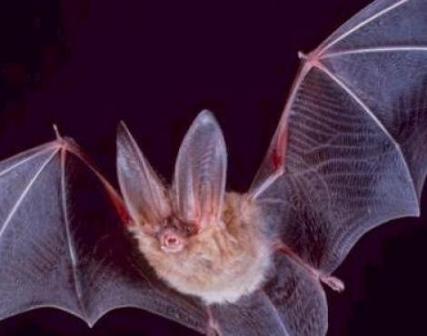
BATH: A new study published in the journal Cell Reports may have uncovered new information on the bat’s ability to fly.
The study found that bats use tiny hairs on their wings to guide their elaborate flights. They are highly-agile fliers, and are capable of carrying out precise maneuvers. This is largely due to the hairs, which are capable of detecting tiny changes in airflow taking place over their wings. Once this occurs, nerve signals generated by the movement of air over the tiny hairs is sent to the brain of the flying mammal. This input then allows the bat to make split-second decisions in directing key things such as flight path and attitude.
You might also like


This find is interesting, and is the first time anyone had ever looked at or studied the sensors on a bat’s wing. These sensors are crucial, and allow it to serve as more than a propeller, a flipper, an airplane wing or any simple airfoil. These findings can inform more broadly how organisms use touch to guide movement. Big brown bats, a species common around the United States, were examined in the study, to surprising results. These creatures use their wings, not just for flight, but also to capture insects, climb along surfaces and cradle their young. While bats make use of echolocation to help guide their flight, they also use the touch sensors to make wing adjustments to stabilize, slow down, and speed up.
During the study, researchers discovered a vast number of touch sensors spread over the wings, and noted that many were located at the base of fine hairs. When these sensors were stimulated by puffs of air, the action lit up signals in the primary somatosensory cortex of the bat’s brain. This suggests that sensors on the wings act as data relay centers, which continually update the flying mammal on current air conditions. Furthermore, when researchers temporarily removed hair on the wings using a cream, the animals were not able to stop their flight as quickly as normal, and turns became wider.