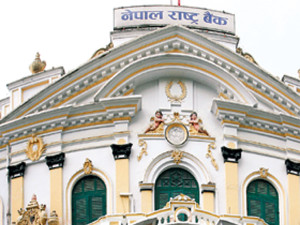
KATHMANDU: Nepal Rastra Bank has called on banks and financial institutions to provide Indian currency in a bid to give respite to people seeking such facility. People have been forced to stand in queues for hours to get Indian currency from the banking offices of NRB, as it has centralised this facility after a surge in demand of INR 100 notes following demonetisation of INR 500 and INR 1,000 on November 8. Earlier, people visiting India could easily get Indian currency from BFIs, as the NRB used to provide exchange facility of up to one million Indian rupees on weekly basis to commercial banks and national level development banks.
After the Reserve Bank of India told NRB that it would not be able to provide Indian banknotes to Nepal until the situation eases in India, the central bank, on November 24, had lowered the exchange facility for people travelling to India and stopped providing Indian banknotes to BFIs. Janak Bahadur Adhikari, executive director at the NRB’s Banking Office in Thapathali, said the central bank stopped providing Indian notes to banks, as they did not seem to be keeping proper track of people seeking the facility and abiding by the limits set by the central bank.


As per new rules, those travelling to India for medical treatment for serious health issues, such as cancer, kidney disease and heart problems, are able to exchange up to INR 25,000. Earlier, such patients were allowed to carry up to INR 50,000. Likewise, pilgrims, students and those travelling for medical check-up (normal cases) will get only INR 10,000 against the earlier limit of up to INR 25,000.
Those who approach NRB seeking exchange facility without any supporting and travel documents are getting only INR 2,000 after submitting a photocopy of their identity card (citizenship certificate or passport) as compared to INR 5,000 earlier. “If the banks are willing to provide the exchange facility to the public as per the new rules, the central bank will provide up to INR 300,000 every week to BFIs based in Kathmandu and up to INR 100,000 to their regional offices outside the Valley.”
Meanwhile, Ashoke SJB Rana, CEO of Himalayan Bank Ltd and former president of Nepal Bankers’ Association, said the banks were ready to facilitate the general public in exchanging Indian currency if the central bank provides INR 100 notes. “The only reason we have not been able to provide Indian currency is because the central bank stopped giving us INR 100 notes after the exchange limit was lowered.”
The central bank has tightened the rules on exchange of Indian currency due to limited reserve of the INR 100 notes with NRB. If the exchange facility in physical cash is limited to INR 500 million per month, the physical cash reserve with the central bank would be enough to serve the demand for six months, according to Adhikari. NRB charges Re 0.15 for exchange of every INR 100 to cover the cost of transportation and insurance.