


Customs Today
  • Home
  • Islamabad
  • Karachi
  • Lahore
  • National
  • Transfers and Postings
  • Chambers & Associations
  • Business
No Result
View All Result
Customs Today
  • Home
  • Islamabad
  • Karachi
  • Lahore
  • National
  • Transfers and Postings
  • Chambers & Associations
  • Business
No Result
View All Result
Customs Today
No Result
View All Result
Home Science & Technology Science

Biophysicists revealed 1st swimming microbes can organize themselves into 2D lattice of rotating cells

byCustoms Today Report
07/04/2015
in Science, Science & Technology
Share on FacebookShare on Twitter

You might also like

Tesla driverless system to use updated radar technology

12/09/2016

Apple to develop its own self-driving technology

10/09/2016

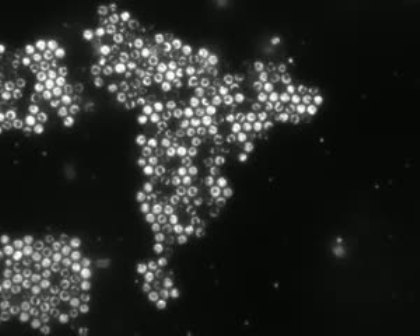
LONDON: Biophysicists have revealed that fast-swimming, sulfur-eating microbes known as Thiovulum majus can organize themselves into a two-dimensional lattice composed of rotating cells, the first known example of bacteria spontaneously forming such a pattern.
“The regular, repeated arrangement of the microbial cells shares the geometry of atoms within a mineral crystal, but the dynamics are fundamentally different; the bacterial crystals constantly move and reorganize as a result of the power generated by individual cells within them,” says study author Albert Libchaber, Detlev W. Bronk Professor and head of the Laboratory of Experimental Condensed Matter Physics.
The single cells’ rotating motion — which forms the crystals by drawing in other cells and then powers the crystals’ own motion — led the researchers to dub them “microscopic tornadoes” in a paper awaiting publication in Physical Review Letters.
It’s no coincidence that Thiovulum majus is among the fastest swimming bacteria known. Capable of moving up to 60 body lengths per second while rotating rapidly, these microbes propel themselves using whip-like flagella that cover their surfaces. But in its natural habitat, deep in marsh water, these microbes don’t travel much. They tether themselves to a surface and use their flagella to generate a current strong enough to pull in the nutrients they need: sulfides from rotting organic matter and oxygen used to burn the sulfides.

Related Stories

Tesla driverless system to use updated radar technology

byCT Report
12/09/2016

WASHINGTON: Electric carmaker Tesla announced Sunday it was upgrading its Autopilot software to use more advanced radar technology. In a...

Apple to develop its own self-driving technology

byCT Report
10/09/2016

SAN FRANCISCO: Apple may not become an automaker, but it still wants to develop its own self-driving technology. The iPhone-maker's...

NASA spots slowest known magnetar

byCT Report
10/09/2016

WASHINGTON: Astronomers have found evidence of a magnetar - magnetised neutron star - that spins much slower than the slowest...

‘YouTubers’ outshining old-school television

byCT Report
09/08/2016

SAN FRANCISCO: A media revolution is taking place, and most people over 35 years of age aren’t tuned in. Millennial...

Next Post

MIT researchers developed a new magnetic field detector

  • Terms and Conditions
  • Disclaimer

© 2011 Customs Today -World's first newspaper on customs. Customs Today.

No Result
View All Result
  • Transfers and Postings
  • Latest News
  • Karachi
  • Islamabad
  • Lahore
  • National
  • Chambers & Associations
  • Business
  • About Us

© 2011 Customs Today -World's first newspaper on customs. Customs Today.
